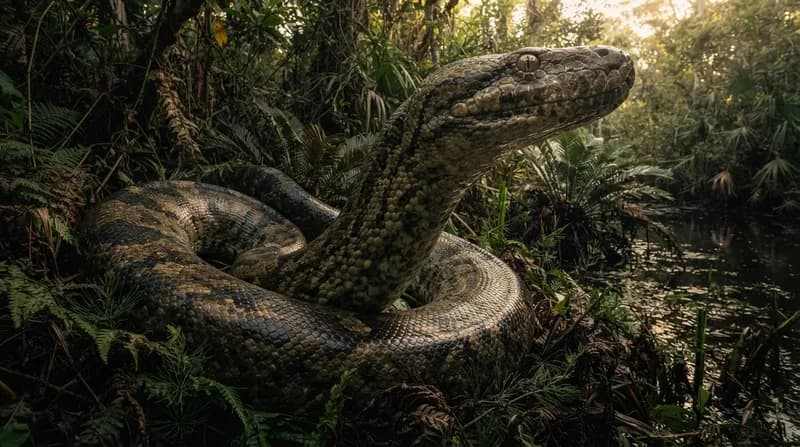
A Titan of the Ancient World
In a groundbreaking discovery that has reshaped our understanding of prehistoric reptilian life, researchers have identified a massive, extinct snake species named Vasuki indicus. Unearthed in the Panandhro Lignite Mine of Kutch, Gujarat, these fossilized remains offer a rare glimpse into the Middle Eocene epoch, a period approximately 47 million years ago characterized by a significantly warmer global climate. The species is named after the mythical serpent Vasuki, a powerful deity in Hindu tradition often depicted coiled around the neck of Lord Shiva, acknowledging both its legendary scale and its Indian origins.
Paleontologists Debajit Datta and Sunil Bajpai of the Indian Institute of Technology Roorkee led the investigation, analyzing 27 well-preserved vertebrae to estimate the creature's dimensions. The results are startling: calculations suggest the snake reached lengths of between 10.9 and 15.2 meters (36 to 50 feet). This places Vasuki squarely alongside Titanoboa—the long-reigning heavyweight champion of the fossil record—as one of the most formidable serpents to ever roam the planet.
Anatomy and Ambush Tactics
The physical structure of Vasuki indicus was defined by its broad, cylindrical vertebrae, which measured up to 111.4 millimeters in width. These proportions suggest a robust, heavy-set body designed for terrestrial or swampy terrain rather than a strictly aquatic lifestyle. Unlike modern predators that hunt through agile pursuit, Vasuki was likely a slow-moving giant, utilizing ambush tactics similar to contemporary anacondas and pythons.
By remaining concealed within the lush, marshy wetlands of ancient India, it likely waited for prey to wander within striking distance before using its massive, muscular coils to overpower and constrict them. This method of predation highlights an evolutionary adaptation to the reptile's sheer mass; while it lacked the speed of smaller hunters, its devastating strength and size likely made it the apex predator of its specific ecological niche.
Why It Matters: The Mechanics of Gigantism
- Climate Influence: During the Eocene, the region averaged temperatures around 28 degrees Celsius (82 degrees Fahrenheit). As ectothermic animals, large snakes rely on these external heat sources to maintain metabolic functions, supporting the idea that a tropical environment is a prerequisite for such massive growth.
- Evolutionary Lineage: Vasuki belongs to the Madtsoiidae family, an extinct lineage that spanned 100 million years. Its discovery suggests a sophisticated dispersal pattern, likely moving from the Indian subcontinent into Eurasia and eventually Africa as tectonic plates shifted.
- Ecological Context: Recent 2025 findings indicate that Vasuki was not an outlier but part of a diverse community of ancient reptiles. Fossils from the same strata reveal a complex ecosystem where different snake species occupied distinct ecological roles, from aquatic environments to dense marshes.
A Shifting Perspective on Ancient Reptiles
The discovery of Vasuki is part of a broader, ongoing effort to map the diversity of life during the Eocene. Further research published in the Journal of Paleontology has highlighted other reptilian neighbors found in the same region, including diverse aquatic snakes and additional madtsoiid relatives. These finds suggest that prehistoric India was a hotbed of evolutionary experimentation, where fluctuating sea levels and land connections allowed for the spread of these giant reptiles across the globe.
While uncertainty remains regarding the exact maximum length of Vasuki, the sheer scale of the fossilized vertebrae provides irrefutable evidence that snake gigantism was a highly successful evolutionary strategy. As scientists continue to synthesize data from these Indian sites alongside parallel studies on ancient anacondas in South America, a clearer picture emerges: the history of life on Earth has been punctuated by massive serpents that successfully mastered the art of surviving and thriving in the world's most challenging, warming landscapes.