The Shift Toward Precision Psychiatry
For more than one billion people worldwide, mental health conditions like depression and anxiety are a constant, often debilitating reality. Currently, clinical diagnosis relies heavily on behavioral assessments and subjective reports, a process that can leave patients waiting weeks or months to see if a specific treatment plan is actually working. Researchers are now looking to bridge this gap by integrating advanced neurotechnology—tools that allow clinicians to measure, map, and potentially regulate brain activity with unprecedented precision.
Sandra Klonteig, a researcher at SINTEF, emphasizes that the brain is a complex, albeit fragile, organ. By leveraging non-invasive sensors, scientists are moving away from the "trial and error" approach that defines modern psychiatry. The ultimate goal is a proactive medical model where biological changes in the brain are detected long before clinical symptoms become apparent to the patient, enabling intervention at the earliest possible stage.
Emerging Non-Invasive Diagnostic Tools
The core of this research involves gathering objective data on brain function without the need for invasive procedures. Several key technologies are currently being refined to provide a clearer window into the neural networks associated with mental health disorders:
- Eye-Tracking: Used to study "attentional bias," this method monitors where a patient focuses their gaze. By understanding whether an individual fixates on negative stimuli, doctors can better identify the cognitive patterns that contribute to depressive spirals.
- EEG (Electroencephalography): This reliable, non-invasive technology uses sensor-equipped headgear to detect and amplify electrical impulses generated by the brain, offering real-time insights into neuronal communication.
- fNIRS (Functional Near-Infrared Spectroscopy): By measuring blood flow changes in the brain, fNIRS identifies which regions are actively consuming energy, providing a detailed map of functional brain activity.
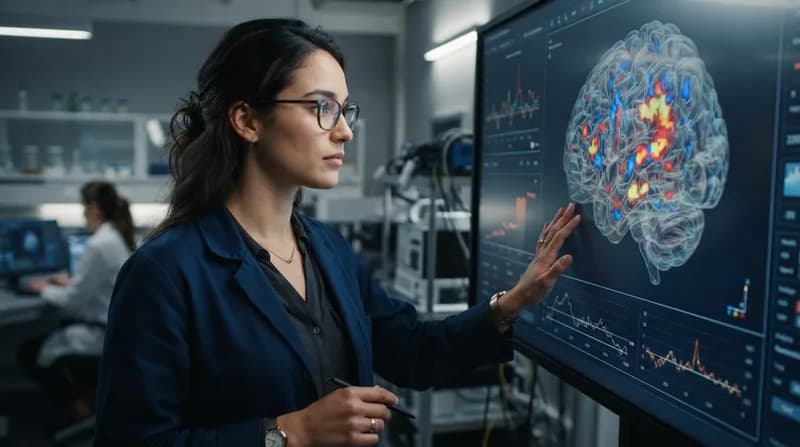
- AI-Powered MRI Analysis: By training artificial intelligence models on massive datasets of brain imagery, researchers are accelerating the detection of structural and functional abnormalities, often identifying critical signs faster than manual human review.
The Frontier of Lab-Grown Neural Models
Beyond external sensors, researchers are turning to biological modeling to better understand how specific nerve cells react to environmental stressors and pharmaceuticals. These "lab-grown" methods reduce the need for testing on living subjects while providing deep insights into neural behavior.
Brain-on-a-chip platforms place fragments of brain tissue or nerve cells onto specialized chips, allowing scientists to simulate complex neural conditions. By using tiny electrodes to capture electrical signals or microscopes to observe cellular reactions, researchers can screen drugs for neurodegenerative diseases with higher accuracy. Complementing this, nerve cell cultivation using stem cells allows scientists to grow specific types of neurons in a controlled environment. This enables the study of brain mechanics in isolation, offering a safer and more ethical route to understanding the underlying biology of mental illness.
Why It Matters
The integration of these technologies represents a seismic shift in mental health. By correlating behavioral psychology with objective biological data, clinicians could soon determine in real-time whether a patient’s brain is responding to a medication. This would prevent the agonizing wait times often associated with finding the right therapeutic "fit." If successful, this evolution in neurotech will transform mental health from a field of subjective diagnosis into one of data-driven, personalized medicine, drastically reducing the emotional and physical burden on patients.