The Challenge of Escalating Context
Modern AI infrastructure is facing a pivotal turning point. As organizations pivot from basic chatbot interactions toward complex reasoning, autonomous agents, and massive context windows, the demand for memory capacity is skyrocketing. The primary culprit is the key-value (KV) cache—a data structure that stores previously generated information so models can avoid redundant computations. Currently, most of this data resides in expensive, capacity-constrained GPU or system memory, creating a severe bottleneck for large-scale deployments.
While traditional storage offers the necessary capacity, it often relies on slow, CPU-mediated data paths. This introduces latency that leaves high-performance accelerators idle, waiting for the data required to complete a single inference task. Huawei’s solution to this architectural friction is the newly announced OceanStor M900 Context Memory Storage, a platform designed to rethink how inference clusters handle long-term context.
The OceanStor M900 Architecture
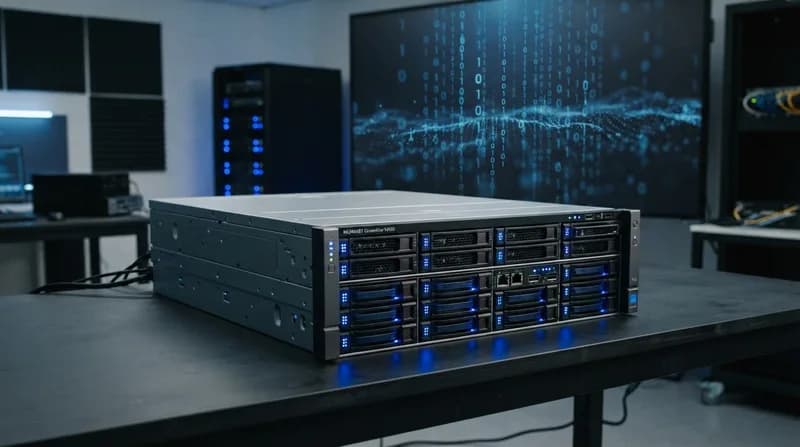
Debuted at Huawei Connect 2026, the OceanStor M900 acts as a dedicated Context Memory Storage layer, effectively extending the KV cache beyond the limitations of local accelerator memory. By utilizing Huawei's high-speed UnifiedBus interconnect, the system allows memory resources to be shared across an entire compute cluster. This creates a massive, multi-tier storage pool capable of scaling up to 64PB, granting NPUs access to significantly more context than previously possible.
The secret to its performance lies in the specialized ASU (Accelerated Storage Unit) disk. This hardware integrates CPU, networking, and storage controller functions into a single unit. By employing native KV semantics, the system enables NPUs to pull cache data in a "single hop," bypassing the overhead of traditional protocol conversion or CPU-heavy forwarding. This streamlining is projected to reduce access latency to approximately 60 microseconds, theoretically doubling token throughput and significantly cutting down the time to the first token in intensive coding and reasoning workloads.
Why it Matters
- Reduced Latency: Cutting access time to 60 microseconds directly impacts the responsiveness of AI agents.
- Scalability: By enabling a shared memory pool, infrastructure can handle much larger datasets than those constrained by local GPU RAM.
- Economic Efficiency: The system boasts an endurance rating of up to 24 drive writes per day, promising 16 times the longevity of standard SSDs, which lowers long-term maintenance costs.
- Holistic Design: The shift signals an industry move toward treating compute, memory, and networking as a singular, unified pipeline rather than distinct silos.
Ultimately, the OceanStor M900 highlights a broader shift in the AI hardware landscape: the infrastructure powering these models is moving toward an era where the retrieval and retention of context are just as vital as raw floating-point performance. By prioritizing the lifecycle management of cache data, Huawei is positioning its hardware to keep pace with the next generation of agentic AI applications.