Hanoi's Green Public Transport Shift
The landscape of public transportation in Hanoi is undergoing a significant transformation as the city-operated transit provider, Transerco, officially commissioned 53 new electric buses into active service. Launched in early October 2026, this fleet marks a major milestone in the capital's aggressive goal to transition its entire bus network to electric or green-energy alternatives by 2030.
The deployment is split between two primary operating divisions: the Cau Buou Bus Enterprise and the Southern Hanoi Passenger Bus Enterprise. Together, these entities are replacing legacy diesel engines on four strategic routes, providing a cleaner, quieter, and more sustainable commuting experience for thousands of daily passengers.
The VinFast EB 8: Specifications and Design
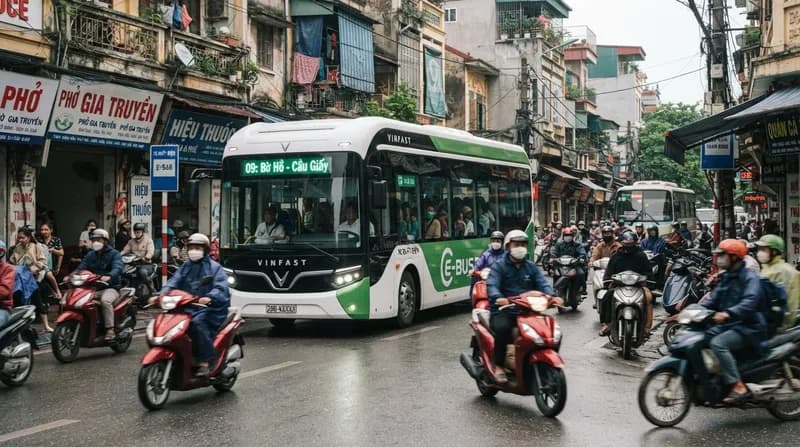
At the heart of this transition is the VinFast EB 8. This medium-sized electric bus, which is easily recognizable by its distinct green branding and traditional Hanoi iconography—including the Khue Van Cac—is specifically engineered for the high-density demands of urban transit. Measuring 8.6 meters in length, 2.5 meters in width, and 3.2 meters in height, the bus balances maneuverability with internal capacity.
The EB 8 is built to accommodate 60 passengers, with a layout that includes 24 dedicated seats, space for 34 standing commuters, and a specific area reserved for a wheelchair. Below the floor, the vehicle is powered by a robust 359 kWh LFP (Lithium Iron Phosphate) battery pack, which is paired with a 200 kW electric motor. This configuration allows for a top speed of 80 kph and provides a respectable range of over 290 kilometers on a single charge.
Technical highlights for the fleet include:
- Battery Capacity: 359 kWh LFP pack.
- Charging: Supports DC fast-charging up to 120 kW via CCS2 connector.
- Performance: 200 kW electric motor with a top speed of 80 kph.
- Passenger Capacity: 60 total (24 seated, 34 standing, 1 wheelchair).
- Dimensions: 8.6m (L) x 2.5m (W) x 3.2m (H).
Why it Matters
This deployment is more than just a purchase of new hardware; it serves as a critical proof-of-concept for Hanoi's broader environmental policy. By targeting the inner urban areas within the city’s Ring Road 4, officials are prioritizing the reduction of localized emissions in the most congested parts of the city. As Transerco continues to swap out its aging diesel fleet, the success of the VinFast EB 8 deployment provides a blueprint for how large-scale electrification can be integrated into existing municipal transit infrastructure without disrupting service reliability.
Outlook and Implications
The commitment to phase out combustion engines by 2030 is one of the most ambitious timelines for any major Southeast Asian city. As the city continues to scale these efforts, the focus will likely shift toward expanding high-capacity charging infrastructure and optimizing route efficiency for electric fleets. For manufacturers like VinFast, this provides a vital case study in the durability and viability of their commercial electric vehicles in real-world, high-frequency transit environments.