The Path Toward Resource Independence
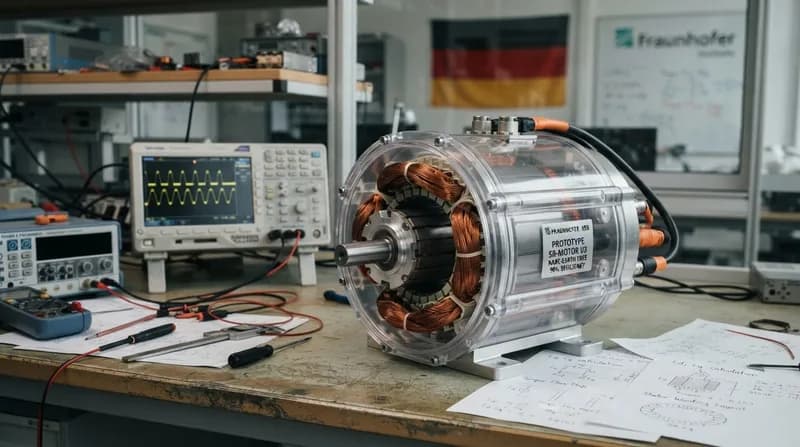
The transition to electric mobility has triggered a massive global scramble for raw materials, with rare earth elements and copper sitting at the heart of supply chain volatility. To mitigate these dependencies, the Fraunhofer Institute for Manufacturing Technology and Advanced Materials (IFAM) in Dresden has launched the SIREN project (Sovereign and Versatile Infrastructure for Resource-Independent Electric Drives of the Next Generation). Supported by over two million euros in funding from the Free State of Saxony and the European Regional Development Fund, the initiative aims to fundamentally rethink how electric motors are designed and manufactured.
Scheduled to run through the end of 2028, SIREN is establishing a specialized research infrastructure focused on sintering-based additive manufacturing. This advanced process allows researchers to combine disparate metallic materials in ways that traditional manufacturing simply cannot achieve. By creating unique component geometries, the team hopes to develop high-performance motors that maintain high power density while significantly reducing the reliance on geopolitically sensitive raw materials.
Designing Beyond Rare Earths
At the core of the SIREN project is the development of innovative motor architectures, specifically high-speed reluctance motors and ferrite-excited permanent magnet drives. By leveraging multimaterial sheet packages—which combine soft-magnetic and non-magnetic materials—the institute aims to eliminate the need for rare earth-based magnets entirely. This design-led approach represents a departure from current recycling-heavy strategies, opting instead to build hardware that is natively efficient without the need for controversial minerals.
Furthermore, the research team is actively investigating the replacement of copper with aluminium in motor windings. While copper is the industry standard due to its excellent conductivity, it is increasingly scarce and expensive. To overcome the thermal challenges associated with aluminium, the researchers are integrating specialized cooling channels directly into the motor architecture. This solution is designed to maintain high performance even when using more abundant materials.
Why It Matters
- Supply Chain Resilience: Reduces Europe’s reliance on concentrated international suppliers for rare earth elements.
- Manufacturing Innovation: Introduces unique sintering-based additive processes that allow for complex, multi-material designs.
- Broad Applicability: While focused on EVs, the research is tailored for high-demand power density applications including aerial, underwater, and industrial machinery.
- Collaborative Ecosystem: The infrastructure is explicitly designed to partner with small-to-medium enterprises and industry leaders in drive and sintering technology.
The SIREN project is poised to function as a bridge between theoretical material science and practical industrial application. By providing a comprehensive development chain—ranging from material synthesis to the creation of functional demonstrators—the Fraunhofer IFAM is setting a new standard for sustainable engineering in the mobility sector. As the industry looks toward long-term sustainability, this focus on design-stage resource independence may prove to be the most critical step in securing the future of the electric vehicle market.