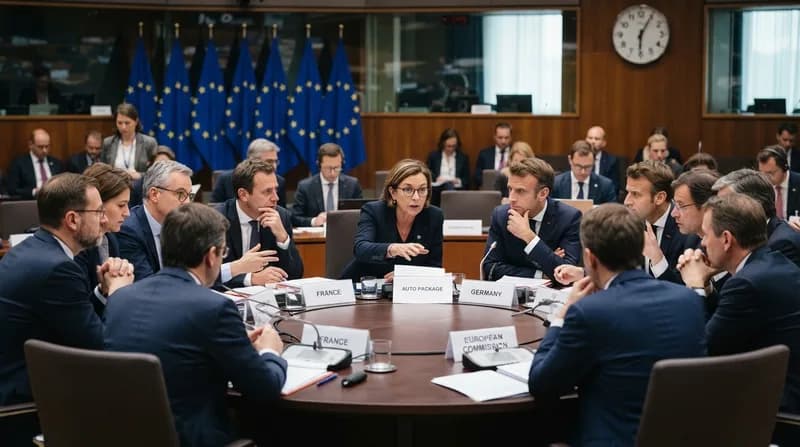
The Roadblock in Brussels
The European automotive sector remains in a state of flux as the European Parliament’s Transport Committee has officially postponed its scheduled October 5th vote on the European Commission’s 'Auto Package.' This legislative bundle is designed to recalibrate the path toward 2035, introducing more flexibility into the EU’s strict CO2 emission standards. According to reports from the EPP and MEP Jens Gieseke’s office, the delay is intended to provide political factions within the 'Centre Platform' additional time to reconcile conflicting interests. The postponement is expected to push the final plenary vote into November, extending a period of uncertainty for major manufacturers.
The 'Auto Package' emerged late in 2025 as a direct response to the deepening crisis facing the European auto industry. With the original goal of phasing out new internal combustion engine (ICE) vehicles by 2035 appearing increasingly difficult to maintain without severe economic fallout, the Commission proposed a shift. Instead of a hard zero-emission mandate, the new target suggests a 90% reduction in fleet CO2 emissions compared to 2021 levels. This adjustment is projected to allow nearly 30% of new registrations to feature combustion technology beyond 2035, provided they meet strict compensation criteria.
Conditional Flexibility and Credit Systems
The proposed legislative framework aims for 'technological neutrality' but attaches specific strings to any continued use of ICE vehicles. The Commission plans to introduce a complex credit system requiring manufacturers to offset emissions generated by non-electric vehicles sold after 2035. This could involve utilizing green steel in manufacturing or incorporating climate-neutral e-fuels and advanced biofuels. While this provides a potential lifeline for traditional engine technology, critics point out that the practical viability and cost-effectiveness of these fuels and materials by 2035 remain significant variables.
Incentivizing Small Electric Mobility
A core component of the 'Auto Package' is the introduction of 'Super Credits,' a strategic measure aimed at revitalizing the market for smaller, affordable electric vehicles. Under this framework, electric cars measuring less than 4.20 meters in length would receive extra weight in the calculation of a manufacturer’s fleet emission averages. For instance, a small electric hatch could be counted as 1.3 units, providing a tangible incentive for automakers to prioritize the development of entry-level EVs rather than focusing exclusively on high-margin, large-format luxury electric models.
Strategic Shifts in Heavy-Duty and Corporate Fleets
Beyond passenger cars, the Commission is introducing flexibility for the commercial sector. For heavy-duty vehicles, the 2030 CO2 reduction targets are slated for a revision that would allow manufacturers to accumulate emission credits more easily by hitting annual targets sooner. Additionally, the proposal mandates that member states must adopt stricter policies to accelerate the electrification of corporate fleets. By looking at successful models like Belgium’s tax-incentive program, the EU hopes to standardize a transition away from ICE company cars, further driving demand for zero-emission alternatives.
Why it Matters
- Economic Resilience: The package serves as a response to intense global competition and the need to protect European manufacturing jobs during the transition to clean mobility.
- Technological Pragmatism: The inclusion of e-fuels and green steel credits acknowledges that a one-size-fits-all electrification strategy may not be feasible for every market segment or region.
- Administrative Relief: The proposal includes a significant push to cut red tape, with the Commission estimating potential annual administrative savings for the industry at over €700 million.
- Investment Boost: The €1.5 billion 'Battery Booster' fund is designed to solidify the European battery value chain, ensuring that the transition to EVs is supported by indigenous manufacturing capacity.