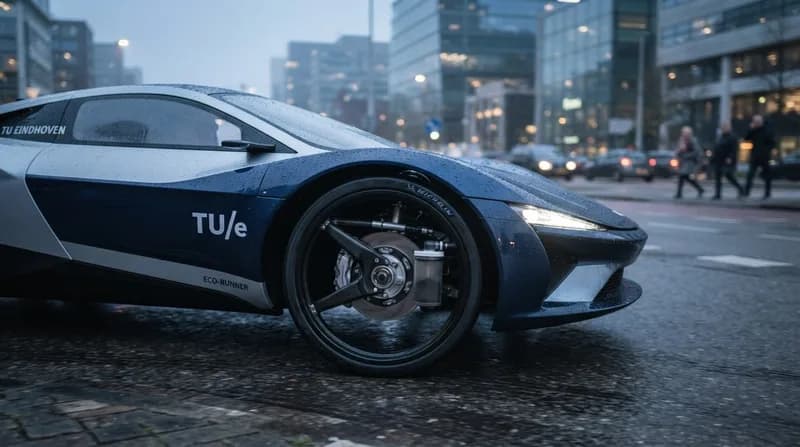
Beyond Tailpipes: The VENTRA Innovation
While the automotive industry has made monumental strides in eliminating tailpipe emissions, a hidden challenge persists: non-exhaust emissions. Even as we transition to electric vehicles (EVs), the friction from tires, brakes, and road surfaces continues to generate fine particulate matter. Students at TU Eindhoven are addressing this critical issue head-on with their latest concept vehicle, VENTRA, a research project designed to capture these pollutants directly at the source before they can enter the atmosphere.
Unlike traditional mechanical filtration systems, which can be cumbersome and inefficient, the VENTRA utilizes an innovative electrostatic approach. By electrically charging the wear particles as they are generated at the wheel, the system guides them toward a grounded collection surface. Once trapped, these particles adhere to the collector, which can then be serviced through standard vacuuming or water-based cleaning methods. While the project remains in the simulation and prototype phase, early data is promising, suggesting that the system could capture up to 42 percent of generated particles at lower urban speeds and approximately 24 percent at highway velocities between 50 and 80 km/h.
Lightweight Design and the Clean-Drive Philosophy
The VENTRA concept does more than just mop up pollution; it actively works to minimize the generation of wear particles through rigorous engineering. The team focused on a dramatic reduction in mass, opting for a chassis constructed primarily from carbon-fiber-reinforced thermoplastic panels. This choice shaves nearly 100 kilograms off the vehicle’s curb weight compared to a standard build. By reducing the overall mass, the vehicle exerts significantly less strain on its tires and brake components during acceleration and deceleration, addressing one of the primary drivers of tire degradation in heavy electric vehicles.
Complementing this hardware-focused approach is the integration of the Clean-Drive system, an intelligent interface that promotes low-wear driving habits. Through real-time analysis of vehicle dynamics, the system provides drivers with actionable suggestions on their screen, such as advising smoother acceleration, encouraging more controlled braking, and minimizing aggressive steering maneuvers. By gamifying efficiency and providing instant feedback, the students hope to influence driver behavior to further extend the lifespan of consumables like tires and brake pads.
Why it Matters
- Regulatory Preparedness: With the implementation of the Euro 7 emissions standard, regulators are finally placing hard limits on non-exhaust particle emissions, making research like VENTRA vital for future compliance.
- Closing the Loop: The team has even explored circularity, testing the potential to recycle captured wear particles into new interior components, effectively turning waste into a resource.
- Tackling EV-Specific Challenges: High torque and increased battery weight are known factors that can accelerate tire wear; this research provides a technical blueprint to mitigate these side effects of the EV transition.
As a dedicated research and demonstration platform, VENTRA serves as a proof-of-concept for the industry rather than a precursor to mass production. However, by shifting the conversation from tailpipe emissions to the broader footprint of vehicle operation, the TU Eindhoven team is highlighting a critical path forward for sustainable mobility. As the EU’s November 2026 regulatory deadline approaches, such technical explorations prove that the next frontier of clean transportation involves far more than just what happens beneath the hood.