The Philosophy Behind the New Roadster
Tesla’s engineering and design leadership, represented by Chief Engineer Lars Moravy and Design Chief Franz von Holzhausen, recently pulled back the curtain on the specifications of the next-generation Tesla Roadster. Far from being a mere iteration of the 2017 concept, the team emphasized that the 2028 production model is a completely ground-up redesign tailored for modern high-performance demands. This vehicle is positioned not as a grand tourer for long-distance travel, but as a specialized track-focused machine built to push the limits of electrical power density and vehicle dynamics.
The chassis is a bespoke construction of aluminum and carbon fiber, engineered for rigidity and lightness, with a projected curb weight of approximately 3,700 pounds. To achieve superior handling, the vehicle incorporates steer-by-wire and brake-by-wire technology, paired with carbon-ceramic rotors for fade-free stopping power. Tesla has opted for a rear-wheel-drive configuration across all four planned variants, utilizing a sophisticated dual-motor setup that facilitates advanced torque vectoring.
Powertrain and Charging Innovations
At the heart of the Roadster is a high-voltage battery architecture operating between 800 and 1,000 volts, utilizing proprietary nickel-based lithium-ion cells. While the initial 2017 vision promised a 620-mile range, the reality of this track-focused beast settles closer to 310 to 320 miles under normal conditions. Tesla has prioritized rapid energy throughput, with a battery system capable of a 500 kW charging input from V4 Superchargers. This allows for a 15% to 85% charge in approximately 10 minutes, making it one of the fastest-charging battery systems in the current automotive landscape.
Performance figures are staggering. The base model offers over 1,073 horsepower and 885 lb-ft of torque, while the most aggressive version pushes output to 1,341 hp and over 1,032 lb-ft of torque. While the current top speed is calibrated to 214 mph, Tesla’s internal engineering target remains an ambitious 330 mph.
Aerodynamics and 'Thrust' Technology
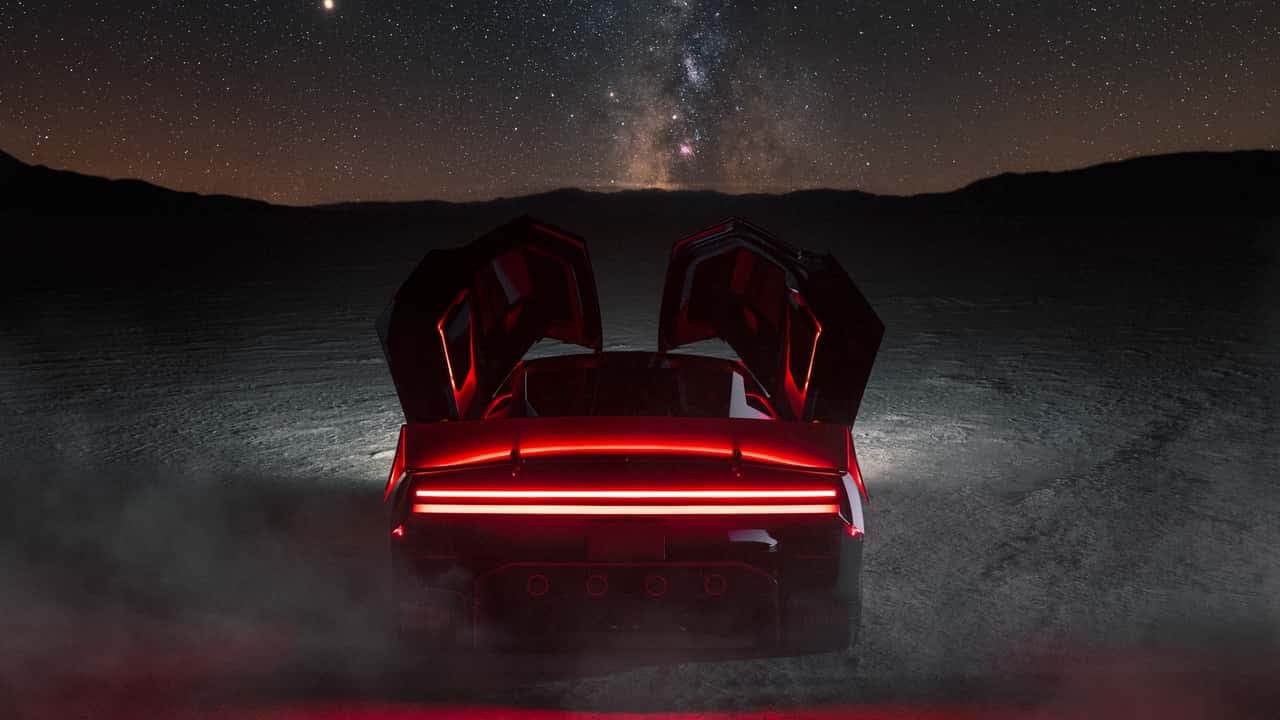
The design deviates from traditional roadster geometry, featuring butterfly doors with removable T-top glass panels. The exterior is a masterclass in active aerodynamics, featuring deployable fans mounted at the rear that pull the car toward the track surface to increase downforce. These fans also create a venturi effect, drawing air from the front and exhausting it through the rear, which helps manage airflow turbulence during high-speed maneuvers.
Perhaps the most unconventional feature is the "Thrust" system, which utilizes a 200-liter pressurized air tank housed in the trunk. This system feeds compressed air through equal-length pipes, providing bursts of acceleration that enable the car to hit 60 mph in under one second. The tank currently requires a nitrogen-based refill process, though Tesla is actively working to reduce the cycle time from hours to under 30 minutes, further cementing the vehicle's status as a technological experiment pushed into production reality.
- Weight: Approximately 3,700 lbs
- Drivetrain: Dual-motor, rear-wheel drive
- Battery Voltage: 800V – 1,000V architecture
- Peak Output: 1,341+ horsepower
- Charging Input: Up to 500 kW