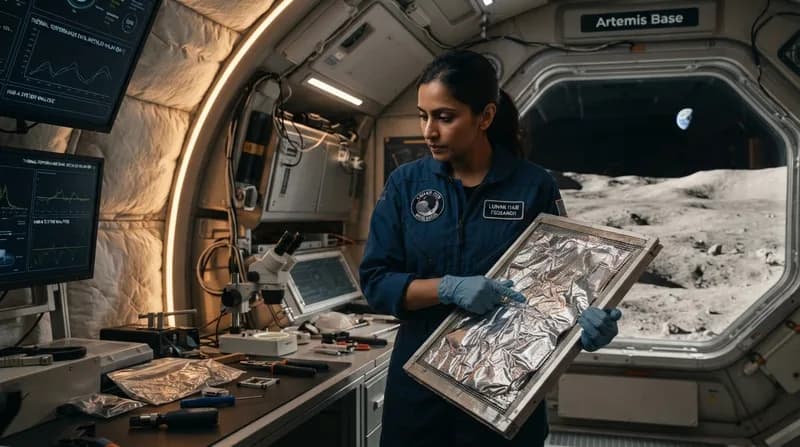
Revolutionizing Lunar Infrastructure with Mylar
Establishing a permanent human presence on the Moon requires more than just high-tech rockets and advanced life support; it demands a radical rethink of how we protect equipment from the lunar surface's brutal temperature swings. Temperatures on the Moon oscillate between hundreds of degrees below zero and extreme heat, creating a challenging environment for conventional insulation. Researchers at the University of Pennsylvania's School of Engineering and Applied Science have discovered a promising solution in an unlikely place: the common Mylar plastic used in lightweight emergency blankets.
By engineering a material known as hybrid layered insulating film stacks (HyLIFS), the team has created a thermal barrier that manages to be both incredibly thin and physically robust. Traditionally, high-performance insulators like aerogels provide excellent thermal protection but fail under the slightest physical stress, making them impractical for the rough-and-tumble reality of space base construction. The Penn engineering team’s approach solves this dilemma by stacking hundreds of individual Mylar sheets to achieve a rare balance of durability and thermal efficiency.
The Engineering Behind HyLIFS
The secret to the material's success lies in the meticulous layering of BoPET (biaxially oriented polyethylene terephthalate) films. While the basic material is identical to commercial food wrap or survival gear, the research team enhanced the sheets with ultra-thin alumina coatings to increase stiffness. This structural reinforcement allows the material to withstand significant compressive stress without collapsing, a critical requirement for habitats where internal air pressure pushes outward against external vacuum conditions.
Testing revealed that these stacks could handle compressive forces as high as 20 megapascals—roughly equivalent to 200 pounds of force concentrated on a fingertip—across ten consecutive cycles without losing their integrity. This resilience ensures that the insulation can survive not only the initial stresses of being packed and transported to the Moon but also the incidental impacts and physical contact that occur during daily life in a lunar outpost.
Why it Matters
- Mechanical Robustness: Unlike aerogels, which are fragile, HyLIFS can survive bending and high pressure.
- Thermal Efficiency: In vacuum conditions, the stacked layers provide thermal conductivity that rivals advanced, purpose-built space insulators.
- Longevity: The ability to endure repeated mechanical stress makes the material ideal for long-term, multi-year lunar missions.
- Scalability Potential: By moving from manual laboratory assembly to industrial-scale continuous coating processes, the material could be produced in large quantities for future space agencies.
Microscopic Clues and Future Implications
During their investigation, the researchers uncovered a critical variable in thermal design: the role of "antiblocking" particles. These microscopic particles are standard in commercial plastic films to prevent sheets from sticking together, but they also serve as conduits for heat transfer between layers. The study suggests that by precisely controlling the distribution and size of these tiny particles, future engineers can further refine how heat travels through the material. This discovery shifts the design focus from merely adding more layers to strategically engineering the physical contact points between them.
While the current samples are small, measuring roughly one square centimeter, the path forward is clear. The researchers are now exploring ways to scale production using roll-to-roll manufacturing techniques. If successful, this humble technology—once intended for the marathon runner's finish line—could eventually shield astronauts living and working on the surface of the Moon, proving that the most advanced solutions are sometimes found in the most common materials.