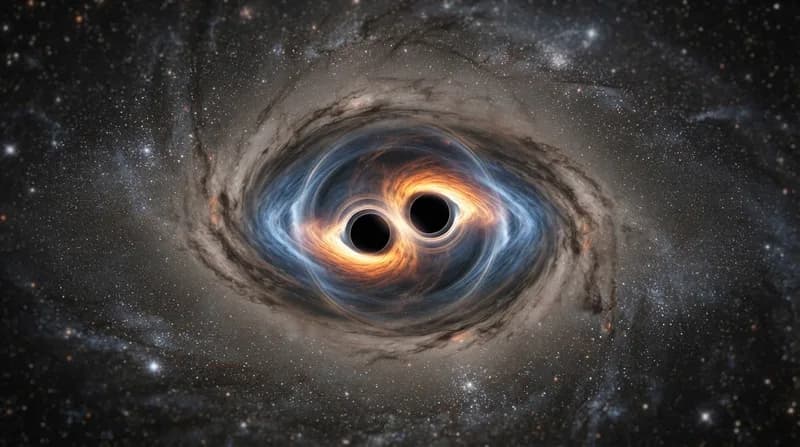
A Hidden Companion in the Heart of Mrk 501
In the vast, silent theater of the cosmos, the center of galaxy Mrk 501 has become the stage for a spectacular and potentially rare event. Astronomers have long observed a single supermassive black hole at the core of this galaxy, identifiable by a powerful, brilliant jet of particles hurtling through space at near-light speeds. However, a multi-decade study led by the Max Planck Institute for Radio Astronomy has fundamentally changed our understanding of this region. By analyzing 23 years of radio telescope data, researchers discovered a second, previously undetected jet that suggests the presence of a massive, unseen companion.
This secondary jet does not merely sit idle; its behavior reveals a dynamic and violent interaction. Unlike the primary jet, which is oriented directly toward Earth, this new feature exhibits movement that researchers describe as a rhythmic, counterclockwise sweep. This oscillation suggests that the two black holes are locked in a gravitational dance, causing their combined orbital plane to sway over time. This discovery provides the first direct imaging evidence of a binary supermassive black hole system, hidden in plain sight due to their extreme proximity and the orientation of their light-emitting structures.
The Math of a Galactic Cataclysm
The implications of this discovery are profound, particularly when examining the orbital mechanics of the pair. Calculations indicate that these cosmic giants complete an orbit around one another approximately every 121 days. While this timeframe might seem leisurely by human standards, it is lightning-fast in the context of galactic evolution. Given the immense mass of these objects—estimated between 100 million and one billion times that of our Sun—the energy required to sustain such an orbit is staggering.
The current separation between the two black holes is estimated to be between 250 and 540 astronomical units. Given these parameters, the researchers suggest that the orbital decay could accelerate the merger process significantly. Depending on the exact mass of the components, this gargantuan collision could occur in as little as 100 years. This would mark a historic moment for astrophysics, as it would provide a front-row seat to one of the most energetic events in the universe—a process that is currently only understood through complex, often speculative theoretical modeling.
Why It Matters
- Evolutionary Insight: Mergers are the primary theory for how supermassive black holes reach their colossal sizes; witnessing one would validate current models of galaxy formation.
- Gravitational Wave Detection: The system is a prime candidate for generating low-frequency gravitational waves, which could be measured by pulsar timing arrays on Earth.
- New Research Methodology: The successful tracking of jet movement over 23 years demonstrates that historical radio data remains a potent tool for modern discovery.
Seeking the Ripples in Spacetime
While the distance to Mrk 501 is too great to resolve the two black holes as distinct entities with current imaging technology, the scientific community is already looking toward alternative detection methods. The most promising route involves the detection of gravitational waves—ripples in the fabric of spacetime caused by the accelerating motion of massive objects. Because these black holes are so massive, their interaction should produce distinct low-frequency waves that pulsars—rapidly rotating neutron stars—might help identify.
By utilizing pulsar timing arrays, which treat these stellar remnants as precise cosmic metronomes, scientists hope to detect the subtle, persistent signature of the binary pair. If confirmed, this would allow astronomers to measure the shrinking orbit of the black holes in real-time. Should the frequency of these waves begin to rise, it would serve as an unmistakable countdown to the inevitable merger, offering a rare opportunity to observe the final, dramatic act of these two galactic titans as they combine into a single, even more massive entity.