Revolutionizing Diagnostics in Remote Regions
In regions where infectious disease outbreaks frequently occur, the ability to rapidly distinguish between lethal pathogens is often the difference between life and death. A multidisciplinary team from Cornell University and the U.S. Army Medical Research Institute of Infectious Diseases (USAMRIID) has announced a major advancement in field diagnostics: a portable, duplex test platform designed to simultaneously detect and differentiate Ebola and Lassa viruses from a single blood sample.
Currently, the early clinical presentation of these two viral hemorrhagic fevers—which includes fever, headache, vomiting, and general fatigue—is remarkably similar. However, the medical response required for each is vastly different, meaning patients in co-endemic regions often face dangerous delays or incorrect triage while waiting for results from centralized laboratories. By shifting testing capabilities away from permanent facilities and directly to the front lines of an outbreak, this new technology promises to streamline critical care decisions.
The PROVIDS Platform: A Laboratory in Your Pocket
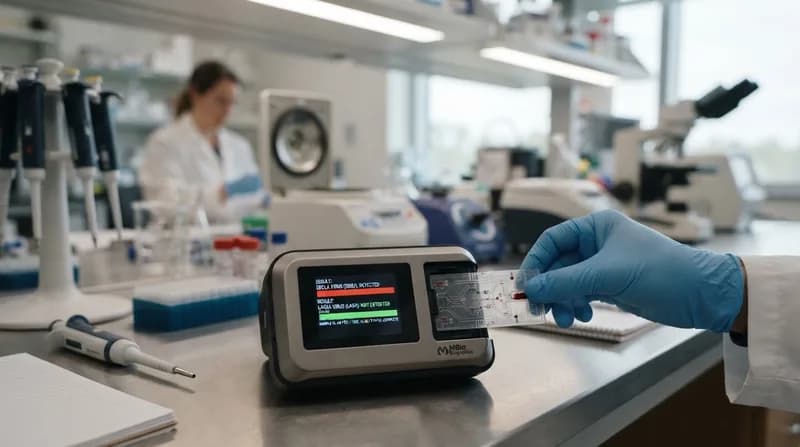
The innovation centers on a device known as the Portable Rapid Onsite Versatile Image-based Detection System, or "PROVIDS." Operating similarly to a standard COVID-19 antigen test, the system utilizes a simple test strip that reacts to specific proteins produced by both viruses. The patient's blood is obtained through a simple finger prick, minimizing the invasiveness of the diagnostic procedure.
Once the sample is applied to the test strip, the PROVIDS unit takes over the analytical heavy lifting. Using a built-in camera, the device photographs the strip and employs specialized software to analyze the results. The system produces an objective, quantitative output in under five seconds, effectively removing the margin of human error that can occur when clinicians must interpret faint visual lines under stressful, field-based conditions.
Why It Matters
- Rapid Triage: By providing immediate results, healthcare workers can initiate the correct treatment protocol or isolation measures within minutes rather than days.
- Field-Ready Durability: The platform is engineered to function in challenging environments, accounting for high heat, unreliable power grids, and the absence of a "cold chain" for refrigeration.
- Objective Data: Automated image processing ensures that results are consistent and independent of the user's level of training, which is vital in remote, under-resourced settings.
- Scalability: Designed for low-cost manufacturing and high shelf stability, the device is intended to be distributed exactly where outbreaks originate, moving the care to the patient rather than forcing patients to navigate to centralized hospitals.
A Collaborative Leap Forward
The project, which saw publication in the journal Analytical Chemistry, was a massive collaborative effort involving experts in mechanical engineering, precision nutrition, and military infectious disease research. The team at USAMRIID was instrumental in validating the diagnostics against high-consequence pathogens, ensuring the platform's reliability in identifying these specific viral threats. This work is a core component of the PORTENT initiative at Cornell, which aims to translate breakthrough diagnostic research into practical, affordable tools that can address infectious threats on a global scale. As research continues to refine these portable diagnostic models—including related projects like the FeverPhone and NutriPhone—the prospect of real-time, point-of-care infectious disease monitoring appears closer than ever.