The Hunt for Microscopic Anomalies
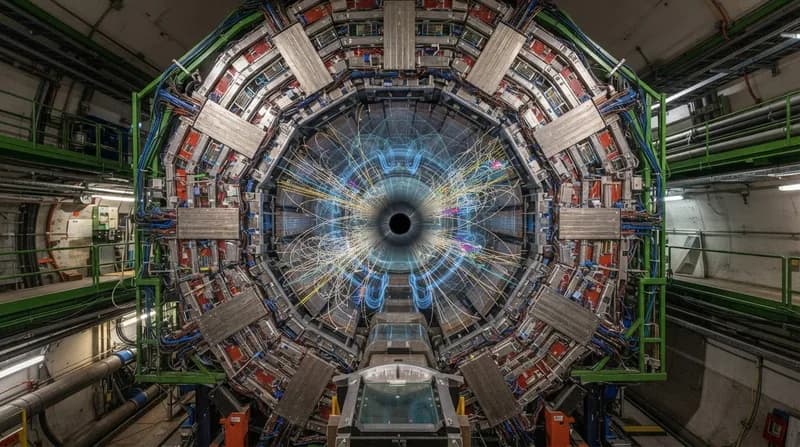
Physicists at UC Santa Barbara, working with data from the Compact Muon Solenoid (CMS) experiment at CERN’s Large Hadron Collider (LHC), have officially reported a null result in their latest hunt for microscopic quantum black holes. While the team did not observe the existence of these exotic, short-lived phenomena, the study serves as a critical milestone in particle physics. By systematically ruling out specific energy ranges and theoretical parameters, researchers have significantly narrowed the field of viable theories regarding gravity and the structure of our universe.
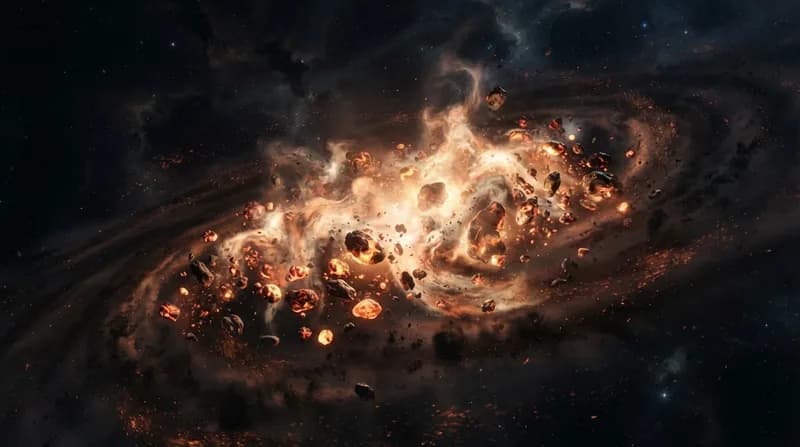
These hypothetical black holes are distinct from their massive, stellar-devouring cousins found in deep space. If they existed, they would be incredibly small and vanish almost instantly upon creation. Finding them would provide the “holy grail” of physics: a direct, measurable interaction that bridges the gap between quantum mechanics—which governs the subatomic world—and general relativity, which explains gravity on a cosmological scale.
Why the Search Continues
The core motivation for this research is the "hierarchy problem," a profound mystery concerning why gravity is remarkably weaker than other fundamental forces. Some leading theories suggest that gravity might appear weak only because it is "leaking" into extra spatial dimensions beyond the three we perceive. If these additional dimensions exist and are accessible at the energy scales reachable by the LHC, gravity would become significantly stronger at tiny distances, potentially allowing the collider to manufacture microscopic black holes during high-energy proton-proton collisions.
Although the experiment did not produce a discovery, the findings provide a vital “exclusion limit.” In the world of high-energy physics, this is considered a significant contribution. It allows scientists to state with mathematical certainty: “If quantum black holes existed with these specific properties, we would have seen them.” By eliminating these possibilities, the team effectively provides a roadmap for where future experiments should focus, preventing wasted effort on theoretical models that are now physically untenable.
Innovative Detection via Machine Learning
This investigation was notable not just for its goal, but for the sophisticated analytical techniques employed. To sift through the massive volume of data collected between 2016 and 2018, the team utilized a novel method known as “phase-space distance.” Developed in collaboration with UCSB theorist Nathaniel Craig, this technique leverages a Support Vector Machine (SVM) to distinguish potential black hole decay signatures from the background noise of standard particle collisions.
Unlike traditional "black box" artificial intelligence, this supervised machine learning approach is mathematically transparent, allowing physicists to scrutinize the logic behind the results. The team compared this new method against the traditional "sphericity" variable—which looks for the spherical decay pattern expected from an exploding black hole—and found that the phase-space distance method offered superior sensitivity. This technological refinement sets a new standard for how researchers might hunt for rare events in future particle accelerator datasets.
The Implications of a Null Result
- Refining Theory: Each null result forces physicists to re-evaluate string theory and models involving extra dimensions.
- Analytical Advancement: The successful integration of SVM and phase-space distance provides a new toolkit for analyzing high-energy physics data.
- Unification Goal: The pursuit remains focused on the century-old ambition of unifying the four fundamental forces into one cohesive theory.
- Safety Confirmation: The study reinforces existing evidence that the LHC is safe and does not produce stable, dangerous black holes.
Ultimately, the work published in the journal Progress in High Energy Physics confirms that science often advances through the rigorous process of elimination. As the team at UCSB continues to probe the limits of our current understanding, the absence of these elusive black holes only heightens the curiosity of what may be hidden in even higher, currently unreachable, energy regimes.