The Future of Off-Grid Charging
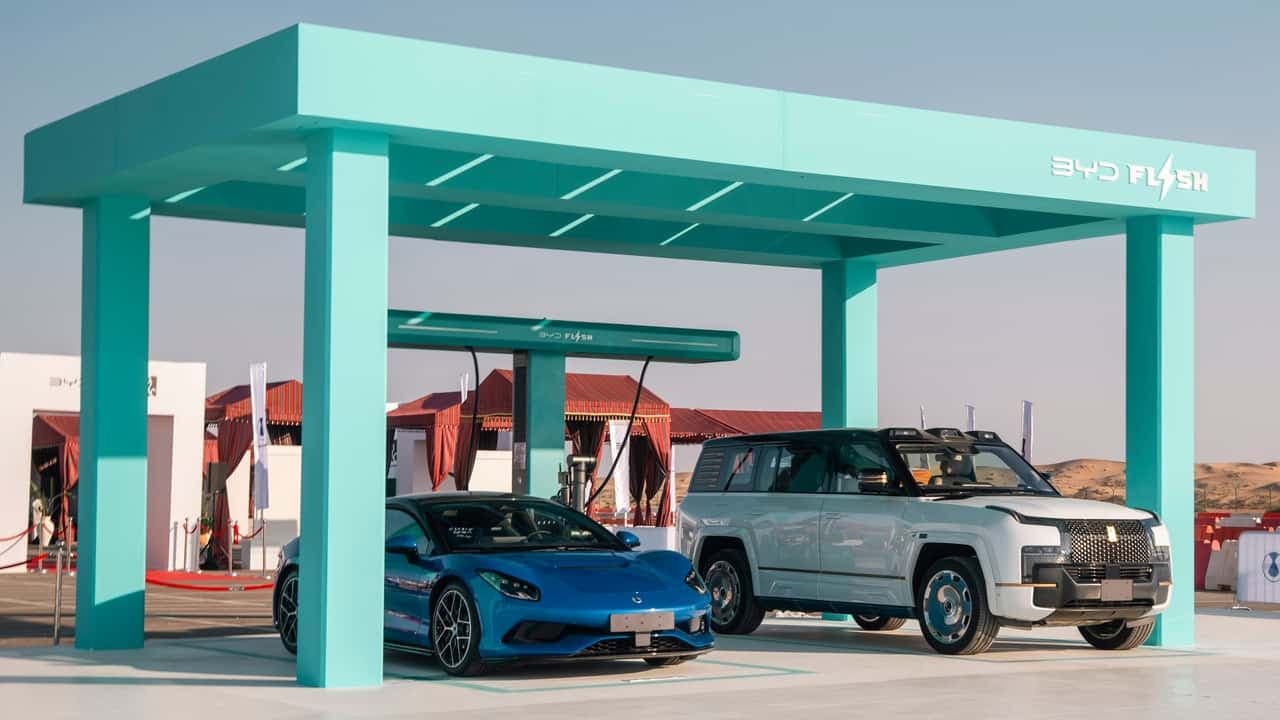
In a bold move to tackle the logistical hurdles of electric vehicle infrastructure, BYD has unveiled a pioneering charging installation in the Abu Dhabi desert that operates independently of the traditional power grid. By integrating solar energy harvesting, high-capacity battery storage, and advanced robotic automation, the company is demonstrating that high-speed charging can be deployed in the most remote locations where grid connections are either unreliable or non-existent.
This innovative setup addresses the "last mile" problem of EV charging, where remote desert highways or rural regions often lack the heavy-duty electrical infrastructure required for ultra-fast charging. The system functions through a cyclical process: integrated solar arrays collect energy during peak sunlight hours, which is then stored in onsite battery modules. This stored energy allows the facility to discharge massive amounts of power to an EV on demand, effectively acting as an energy buffer that protects the station from the constraints of local utility limitations.
Robotic Automation and Flash Charging
The standout feature of this desert installation is its automated, hands-free operation. Utilizing a specialized robotic arm, the station can identify the vehicle’s charging port and initiate the connection process without any human intervention. This integration of automated parking and mechanical plugging streamlines the user experience, eliminating the manual labor usually associated with heavy, high-voltage charging cables.
Behind this automation lies BYD’s proprietary Flash Charging technology, which is designed to handle extreme power throughput. While the precise output specs for this desert unit remain under wraps, BYD’s standard Flash chargers are capable of delivering up to 1,500 kW through a single cable. This extreme power enables compatible vehicles, such as those equipped with the brand's second-generation Blade battery, to achieve remarkable milestones: charging from 10% to 70% in just five minutes, and hitting 97% capacity in under ten minutes.
Why It Matters
- Grid Independence: By utilizing solar and onsite battery storage, these stations can function in remote regions without needing expensive, high-voltage grid upgrades.
- Hands-Free Experience: The implementation of a robotic arm demonstrates a clear path toward fully autonomous vehicle maintenance.
- Scaling Fast Charging: BYD has set an ambitious target of installing 6,000 Flash Charging stations globally by the end of 2027, signaling a major push to standardize ultra-fast charging speeds.
- Infrastructure Versatility: Battery-backed charging systems reduce the peak load on public utility grids, making it easier for cities to host multiple high-speed chargers simultaneously.
A Global Infrastructure Strategy
BYD’s desert experiment is part of a larger, global roadmap to normalize ultra-fast charging. While the solar-powered robotic station serves as a proof-of-concept for remote utility, the company is actively expanding its Flash Charging footprint across Europe, with operational sites already live in Germany, Italy, France, and the UK. With Canada also on the list for future expansion, BYD is clearly positioning its proprietary charging tech as a universal standard for its premium electric fleet.
As these technologies move from experimental prototypes to mass deployment, the focus shifts to compatibility and reliability. The real-world performance of these chargers is already being demonstrated by vehicles like the Denza Z9 GT, which has proven capable of sustaining the high power intake required for sub-seven-minute charging cycles. As BYD continues to refine its off-grid storage and robotic integration, the vision of "filling up" an EV with the same speed—and perhaps more convenience—than a traditional combustion vehicle is becoming an undeniable reality.