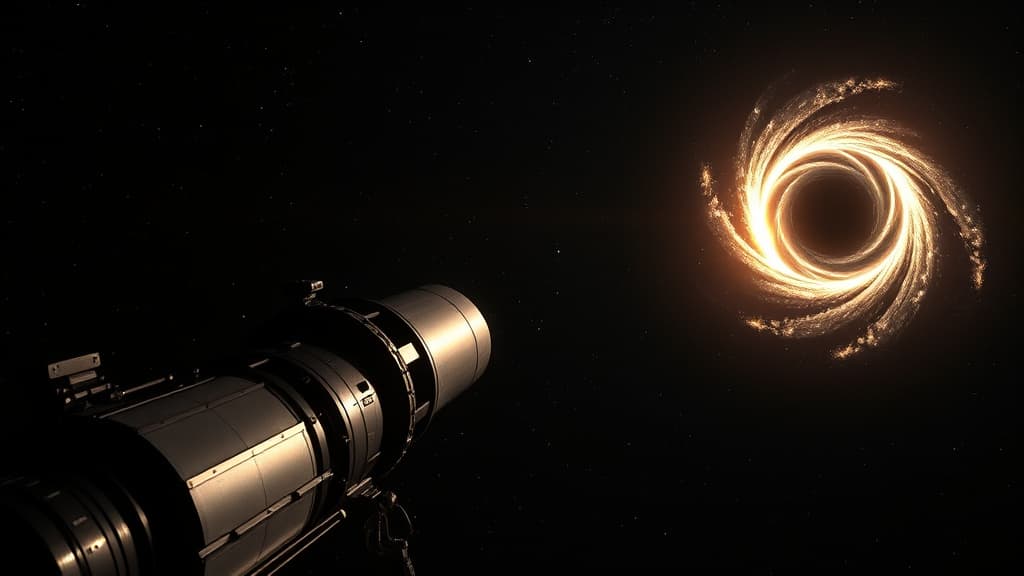
A Cosmic Anomaly in the Early Universe
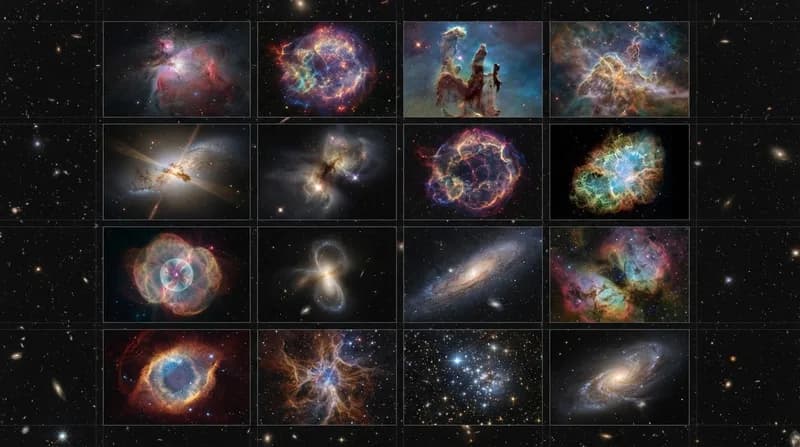
The James Webb Space Telescope (JWST) continues to push the boundaries of cosmic discovery, this time peering into the universe's infancy to uncover an object unlike anything seen before. Astronomers have identified a perplexing red entity, just a few hundred million years after the Big Bang, that defies current stellar classifications. Dubbed a “black hole star,” this mysterious object exhibits a brilliance that outshines known stars by an astonishing margin, prompting scientists to rethink the origins of cosmic structures.
This peculiar celestial body is not a star in the conventional sense, yet it mimics a stellar appearance. Its incredible luminosity, calculated to be 100 billion times brighter than a typical star, is the primary clue to its unusual nature. Researchers hypothesize that this isn't a singular, colossal star, but rather a colossal black hole, approximately 100,000 times the mass of our Sun, shrouded within a dense, star-like envelope of hydrogen gas. This hydrogen cocoon is estimated to be roughly the size of our entire solar system, creating a truly unique and powerful cosmic spectacle.
The discovery holds immense significance for understanding the early universe. Such an object, combining the characteristics of a supermassive black hole and a stellar-like envelope, could represent a crucial step in the formation of the first massive black holes. These primordial black holes are thought to have been the seeds for the colossal galactic black holes we observe today. The JWST's ability to detect such faint and distant phenomena is providing unprecedented insights into the conditions and processes that shaped the cosmos during its earliest and most turbulent phases, promising to rewrite chapters in our astrophysics textbooks.