E-BUZZ ME Logo
ScienceTechnical Deep Dive

ATLAS Experiment Observes Excess in Top-Antitop Quark Interactions

Published
ATLAS Experiment Observes Excess in Top-Antitop Quark Interactions
1 min read154 words

The Gist

Physicists at the ATLAS experiment have detected a notable excess in top-antitop quark interactions near the production threshold, potentially signaling new physics.

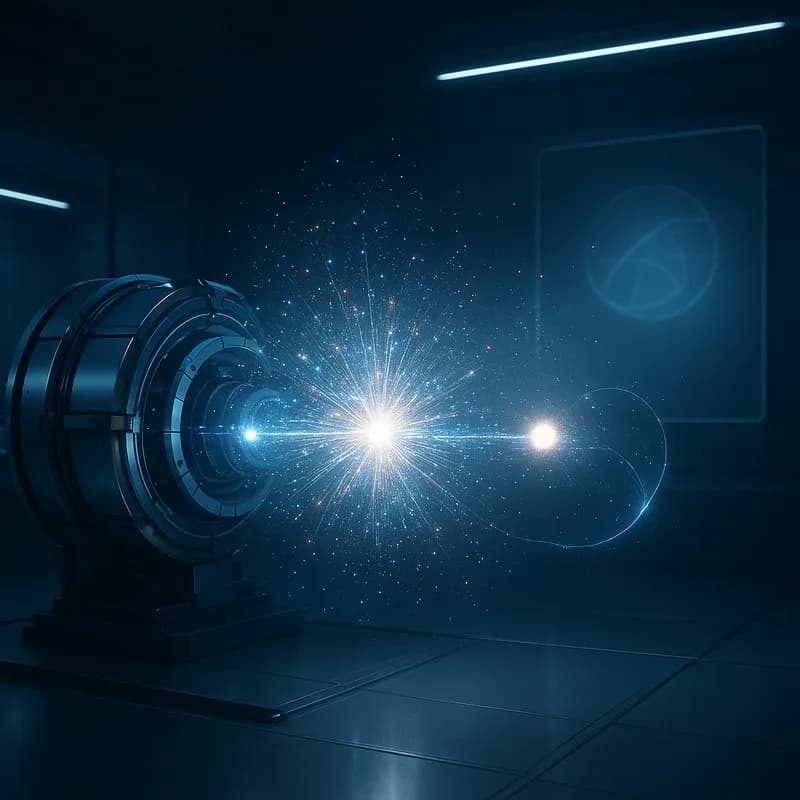
Researchers working with the ATLAS experiment at the Large Hadron Collider (LHC) have reported a significant observation regarding top-antitop quark pairs. By probing these interactions near the energy threshold, the team identified an excess that challenges current standard expectations.

Probing the Threshold

The top quark is the heaviest known fundamental particle, and its interactions are critical to our understanding of the universe's building blocks. The ATLAS collaboration focused their analysis on the production of top-antitop pairs specifically at the threshold—the point where the energy is just sufficient to create the pair.

Potential for New Physics

This observation of an excess is particularly intriguing for the scientific community. While the Standard Model provides a robust framework for particle physics, discrepancies at these high-energy scales often point toward 'new physics' or previously unobserved phenomena. The precise measurement of these interactions allows scientists to test the limits of current theories and refine our understanding of quantum chromodynamics.


Related Stories

Semantically matched articles, ranked by topic overlap and freshness.

New Class of Magnons Exhibits Hundred-Fold Increase in Lifespan
Science68%

New Class of Magnons Exhibits Hundred-Fold Increase in Lifespan

A breakthrough discovery of long-lived magnons could pave the way for scalable, nanoscale quantum information technologies on-chip.

GPS Satellite Network Provides Two Decades of Space Radiation Data
Science68%

GPS Satellite Network Provides Two Decades of Space Radiation Data

A massive cross-calibration effort involving 25 GPS satellites has unlocked twenty years of continuous space radiation tracking.

John Bell and the Legacy of the Journal 'Physics'
Science66%

John Bell and the Legacy of the Journal 'Physics'

A look back at the short-lived journal where John Bell published his ground-breaking theorem, forever changing our understanding of quantum mechanics.

The Physics Behind the Snap: Understanding the Venus Flytrap
Science66%

The Physics Behind the Snap: Understanding the Venus Flytrap

New research delves into the complex physics that allows the Venus flytrap to snap shut with incredible speed to capture its prey.

The Future of Open Access: Navigating Structural Challenges and AI Integration
Science66%

The Future of Open Access: Navigating Structural Challenges and AI Integration

As the scientific community pushes for an open-access future, experts warn that systemic issues and the rise of AI must be addressed to ensure sustainability.

China’s Tianwen-1 Orbiter Captures Rare Footage of Interstellar Comet 3I/ATLAS
Science60%

China’s Tianwen-1 Orbiter Captures Rare Footage of Interstellar Comet 3I/ATLAS

The Tianwen-1 Mars orbiter has successfully imaged the interstellar visitor 3I/ATLAS, providing a rare look at material originating from outside our solar system.

New Giant Salamander Species Identified from 3.5-Million-Year-Old Japanese Fossils
Science59%

New Giant Salamander Species Identified from 3.5-Million-Year-Old Japanese Fossils

Researchers have identified a new genus and species of giant salamander, Limnospondylus ajimuensis, from fossils originally discovered over two decades ago.

Sweden Explores Rare Earth Deposits to Challenge Global Supply Dominance
Science58%

Sweden Explores Rare Earth Deposits to Challenge Global Supply Dominance

Researchers are mapping Sweden's mineral wealth to create magnets from natural element combinations, aiming to reduce reliance on Chinese exports.