A New Frontier in Nano-Imaging
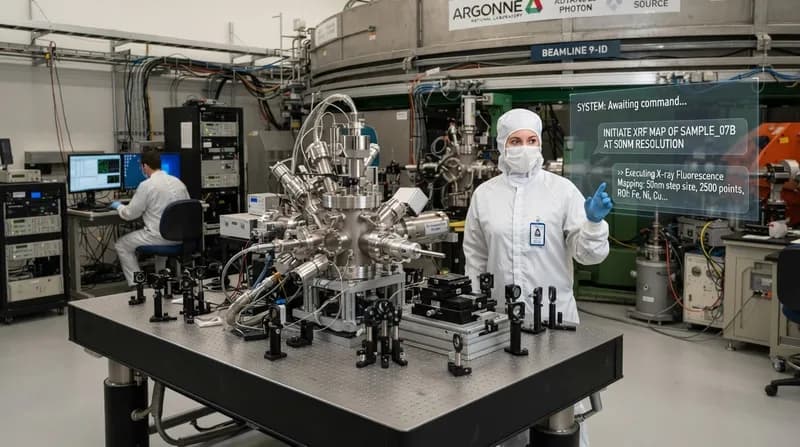
Researchers at Argonne National Laboratory have achieved a significant milestone in scientific instrumentation by integrating an agentic AI platform directly into their 26-ID hard X-ray nanoprobe beamline. This advancement transforms the microscope from a complex, manual-operation instrument into a responsive, intelligent partner capable of conducting nanoscale imaging experiments based on natural language instructions.
The system excels at ptychography—a technique that captures massive volumes of diffraction patterns as X-rays interact with a sample. In traditional setups, processing these datasets can take human researchers days of intensive work. However, by leveraging AI, Argonne’s system performs real-time image reconstruction as the data arrives, effectively turning a bottleneck into an automated pipeline for discovery. By simply speaking to the machine, researchers can direct the beam to specific regions of a sample, such as the interface layers of a microelectronic circuit, and receive instant visual analysis.
The SYNAPS-I Initiative
This development is a centerpiece of the broader Synergistic Neutron and Photon Science-Intelligence (SYNAPS-I) project. Backed by the Department of Energy as part of the presidential Genesis Mission launched in late 2025, this initiative aims to embed advanced AI across the nation’s major scientific user facilities. The project involves a collaborative effort between Argonne, Lawrence Berkeley, Brookhaven, SLAC, and Oak Ridge National Laboratories.
The integration of agentic AI represents the second phase of this multi-stage effort. While the initial phase focused purely on accelerating the computational speed of image processing, this new phase introduces the "chatty" interface that lowers the barrier to entry for scientific exploration. By offloading the technical minutiae of beamline operation to an intelligent agent, scientists can focus on high-level inquiries rather than the intricacies of instrument calibration.
Why It Matters
- Democratization of Research: The conversational interface allows researchers from diverse backgrounds to utilize high-end X-ray nanoprobe technology without requiring years of training on specific beamline hardware.
- Closed-Loop Autonomy: The AI doesn't just collect data; it analyzes results in real-time, flags anomalies, and autonomously decides where to zoom in for further investigation.
- Speed of Discovery: By eliminating manual data processing delays, the time from raw experiment to actionable result is compressed from days to mere moments.
- Broad Applicability: While microelectronics were the test case, this technology is designed to accelerate advancements in materials science, chemistry, and semiconductor manufacturing.
The Future of Self-Driving Microscopy
According to Argonne computational scientist Mathew Cherukara, the goal is to establish a future defined by self-driving microscopes and closed-loop experimentation. The ability of the microscope to perform automated defect detection and follow-up investigations marks a significant step toward autonomous laboratories that operate around the clock.
As the lab continues to refine the system, it is clear that this "chattier" microscope is designed to act as a force multiplier for the scientific community. By abstracting the complexity of the hardware away from the user, Argonne is opening doors for a new generation of scientists to explore the nanoworld with unprecedented speed and accessibility, signaling a paradigm shift in how we interact with the tools of modern physics.