The Era of Hybrid Intelligence
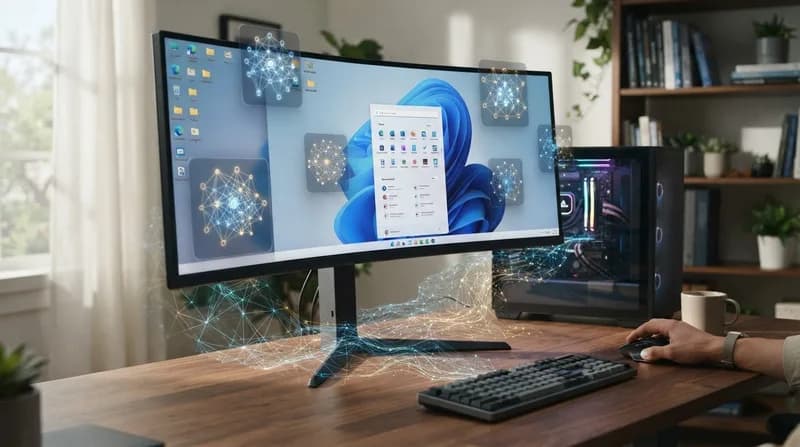
Microsoft has announced a significant shift in how Windows interacts with artificial intelligence, introducing a concept dubbed 'hybrid intelligence.' This new architecture, powered by the HydraFusion model router, is designed to intelligently decide whether an AI task should be handled locally on a user's machine or dispatched to the cloud. By leveraging both on-device processing and massive foundation models like GPT-6 or Claude, Microsoft aims to balance performance, privacy, and computational power.
The backbone of this system is the integration of Microsoft Execution Containers (MXCs). These specialized, permission-gated sandboxes are designed to contain local AI agents, ensuring that while the software has deep access to user files to perform complex tasks, it remains strictly governed. According to Microsoft, this approach allows for high-level productivity, such as autonomously organizing documents or drafting emails with attachments, without inherently compromising the user's data security.
The Role of Windows ML and Llama.cpp
To facilitate this local processing power, Microsoft is significantly expanding the capabilities of Windows ML. By extending support for Llama.cpp within the Windows ML framework, the company is enabling local AI models to tap into a wider array of hardware accelerators. This integration is critical for maintaining responsiveness in a hybrid environment, allowing the system to utilize the full potential of modern silicon, such as the new Nvidia N1X processors found in the latest Surface Laptop Ultra.
This technical shift moves the AI agent experience closer to the user, theoretically reducing latency and offloading traffic from Microsoft’s cloud infrastructure. By keeping routine or privacy-sensitive queries on-device, Microsoft expects to mitigate the privacy concerns that have persisted since the launch of the first Copilot+ PCs, while simultaneously providing a more robust, low-latency interface for everyday operating system tasks.
Why it Matters
- Privacy-First Processing: By running agents locally within MXCs, the system limits the exposure of sensitive files to cloud-based model training.
- Intelligent Routing: The HydraFusion router dynamically determines whether a request requires the lightweight speed of a local model or the deep reasoning capabilities of a cloud-hosted LLM.
- Hardware Synergy: With new support for Llama.cpp and updated SoC optimization, the Windows OS is becoming a dedicated platform for high-performance edge AI.
- OS-Level Integration: From surface-level settings like toggling dark mode to complex document management, AI is becoming a native component of the Windows workflow.
As these features roll out to GitHub Copilot and the broader Copilot app over the coming months, the implications for daily computing are profound. Users will increasingly rely on agentic workflows to navigate file systems and automate administrative drudgery. However, the true test will be how these local models impact hardware performance, specifically regarding battery drain and system heat under sustained workloads. As Microsoft pushes forward with this hybrid strategy, the PC is effectively being reimagined as a personal AI workstation rather than just a traditional desktop environment.