E-BUZZ ME Logo
ScienceTechnical Deep Dive

Ancient Reptile Fossil Unveils Lost Chapter in Evolutionary History

Published
Ancient Reptile Fossil Unveils Lost Chapter in Evolutionary History
1 min read122 words

The Gist

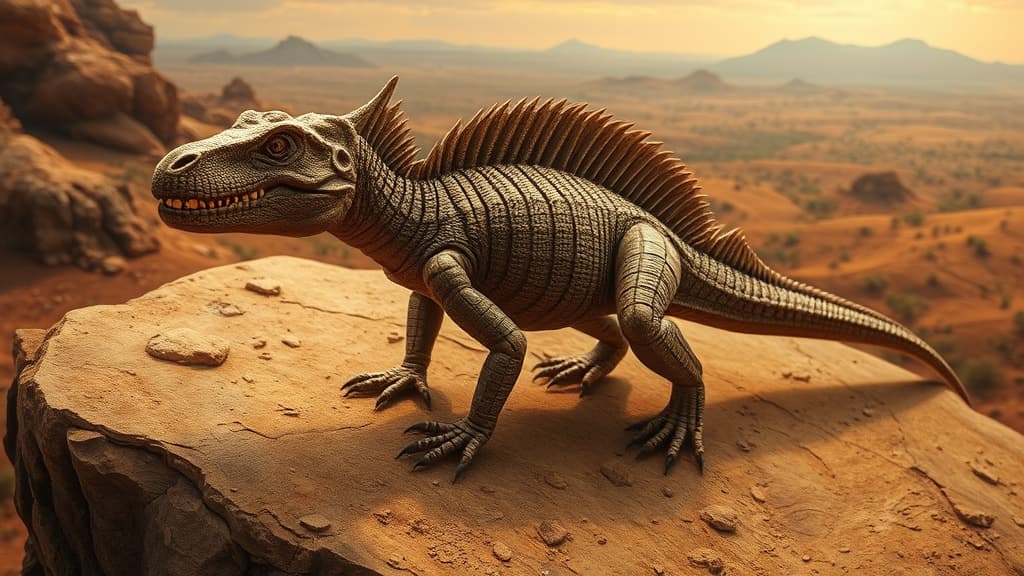
A 240-million-year-old reptile fossil discovered in Brazil is shedding light on the evolution of animals before the emergence of dinosaurs and crocodiles. The fossil, named Silescelida acristata, reveals a complex and previously unknown chapter in the history of life on Earth, broadening our understanding of archosauriform evolution.

The discovery of a 240-million-year-old reptile fossil in Brazil is providing significant insights into the evolution of animals before the rise of dinosaurs and crocodiles. This ancient creature, named Silescelida acristata, is a small predator with unusually positioned legs, offering a unique perspective on the evolutionary history of archosauriforms.

Key Insights

The Silescelida acristata fossil is notable not only for its age but also for its significance in filling an important gap in our understanding of archosauriform evolution. As a group, archosauriforms gave rise to dinosaurs and crocodiles, making this discovery crucial for a more comprehensive understanding of these iconic species' origins. The fossil's discovery in the interior of Brazil's Rio Grande do Sul state underscores the region's importance in paleontological research.


Related Stories

Semantically matched articles, ranked by topic overlap and freshness.

Protein Secreted by Immune Cells May Accelerate Brain Aging
Science

Protein Secreted by Immune Cells May Accelerate Brain Aging

Researchers at Weill Cornell Medicine have identified a protein called DLK1, secreted by immune cells in the brain, which may contribute to brain aging and increased risk of neurodegenerative diseases. The discovery sheds light on the potential mechanisms driving brain aging and could lead to new therapeutic strategies for age-related brain disorders.

Cell-inspired Nanoreactor Turns Sunlight into Hydrogen Peroxide
Science

Cell-inspired Nanoreactor Turns Sunlight into Hydrogen Peroxide

Researchers have developed a cell-mimicking nanoreactor that efficiently produces hydrogen peroxide using visible light, offering new possibilities for cleaner chemical manufacturing. This innovation could pave the way for more efficient artificial photosynthesis methods, leveraging sunlight to create valuable chemicals.

Dirty Air May Trigger Painful Rheumatoid Arthritis Flares
Science

Dirty Air May Trigger Painful Rheumatoid Arthritis Flares

A new study reveals that fine-particle air pollution may increase inflammation and trigger rheumatoid arthritis flare-ups, especially after prolonged exposure. By avoiding poor air quality, patients may be able to better manage their disease and reduce the frequency of painful flare-ups.

Sperm Teamwork Challenges Classic Fertilization Theory
Science

Sperm Teamwork Challenges Classic Fertilization Theory

A groundbreaking study reveals that in many arthropod species, sperm work together in coordinated teams to fertilize an egg, contradicting the traditional 'fastest sperm wins' narrative. This discovery has significant implications for future fertility research and pest-control strategies, offering a fresh perspective on the complex process of fertilization.

Ancient Fossils Uncovered: 567-Million-Year-Old Secrets Revealed
Science

Ancient Fossils Uncovered: 567-Million-Year-Old Secrets Revealed

A groundbreaking discovery in Canada's Northwest Territories has unearthed 567-million-year-old fossils, potentially representing the earliest animals to exhibit complex behaviors. This finding rewrites the timeline of animal evolution, suggesting that sophisticated life forms may have originated in the deep ocean.

Colossal Magma System Discovered Beneath Tuscany
Science

Colossal Magma System Discovered Beneath Tuscany

A massive, unsuspected magma reservoir has been detected deep beneath Tuscany, with a volume of approximately 6,000 cubic kilometers. The discovery could have significant implications for the search for geothermal energy and critical minerals, made possible by the use of ambient noise tomography, a seismic imaging method.

Dinosaurs' Size Limit: Why They Never Became Tiny
Science

Dinosaurs' Size Limit: Why They Never Became Tiny

Research suggests that dinosaurs could grow to enormous sizes, but competition with early mammals may have prevented them from becoming truly tiny, with the smallest known dinosaurs weighing around one pound. The study proposes that ecological factors, rather than physiological limitations, may have imposed a lower size limit on dinosaurs, occupying niches that could have supported smaller species.

Unearthing the Dodo's Hidden Senses: New Scans Reveal Surprising World
Science

Unearthing the Dodo's Hidden Senses: New Scans Reveal Surprising World

New scientific research, utilizing advanced CT scans of rare dodo skulls, is peeling back the layers of time to reveal unexpected sensory capabilities and behaviors of the iconic, extinct bird.