A Prehistoric Discovery in Davinópolis
In a remarkable intersection of modern infrastructure development and ancient history, paleontologists have identified a massive new dinosaur species beneath a rail terminal construction site in Davinópolis, Brazil. The discovery of *Dasosaurus tocantinensis* provides a rare glimpse into the Lower Cretaceous period, roughly 120 million years ago, and is already challenging established theories regarding the migration patterns of giant sauropods.
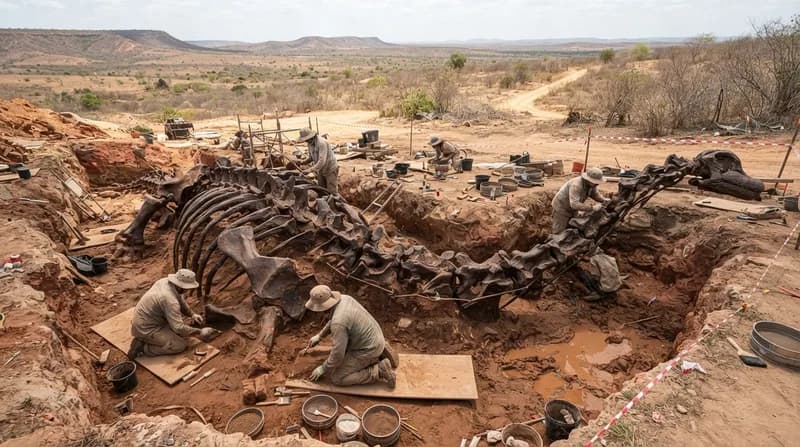
Initially misidentified by workers as remains of large Quaternary mammals, the fossils were preserved at a depth of eight meters. Once experts confirmed the geological age of the surrounding rock, a multidisciplinary team was assembled to excavate the site. The findings, recently published in the Journal of Systematic Palaeontology, reveal an animal reaching 20 meters in length, significantly larger than other known sauropod species previously identified in the Maranhão state.
The European Connection
Perhaps the most significant aspect of *Dasosaurus tocantinensis* is its clear evolutionary kinship with European dinosaurs, specifically those previously found in Spain. This link suggests that the ancestors of this giant reptile likely traversed ancient land connections spanning North Africa, Europe, and South America during a time when these continents were still part of the massive Gondwana supercontinent. This discovery supports the theory that these landmasses served as a dispersal route for titanosaurs and their relatives long before the Atlantic Ocean widened into its current expanse.
The specimen is unusually complete for a dinosaur of this scale. Researchers have successfully recovered critical diagnostic elements, including multiple tail vertebrae, a massive 1.5-meter femur, various ribs, and limb bones. This level of skeletal preservation offers scientists an unprecedented opportunity to analyze growth patterns and biological development through histological examination, potentially explaining how these animals managed to reach such gargantuan proportions.
Implications for Paleontology and Conservation
The naming of the species—*Dasosaurus* meaning "forest" and *tocantinensis* honoring the nearby Tocantins River—serves as a tribute to the region's unique geography. However, the discovery also highlights a recurring tension between Brazil's industrial growth and its rich fossil heritage. The site was only excavated because of rigorous environmental licensing requirements that mandated the presence of archaeologists, yet the team believes the current find represents only a fraction of the total skeletal material buried at the location.
Key Scientific Takeaways
- Size and Scope: At 20 meters in length, this species represents the largest known dinosaur in the Maranhão region.
- Evolutionary Insight: Microscopic analysis of the bone structure suggests that advanced growth and remodeling traits emerged earlier in the dinosaur lineage than previously believed.
- Preservation Challenges: The incident underscores the urgent need for consistent, specialized monitoring at major infrastructure sites to ensure that industrial progress does not come at the cost of erasing natural history.
Researchers are currently in negotiations to return to the Davinópolis site. By securing further excavation permissions, the team hopes to uncover the remainder of the specimen, which could yield even more definitive data on the evolutionary timeline of the Somphospondyli group. For now, the discovery stands as a testament to how accidental findings during mundane construction can shift our fundamental understanding of global biogeography.