A Prehistoric Marine Pioneer
In a groundbreaking discovery that challenges our understanding of amphibian evolution, researchers have identified a fossilized creature that lived entirely in the ocean 237 million years ago. Named Gerrothorax maritimus, this Triassic-era amphibian breaks the cardinal rule of its class: while modern amphibians are famously confined to freshwater or terrestrial habitats due to their permeable skin, this ancient behemoth thrived in the saline-rich depths of the prehistoric sea.
The discovery, published in Nature Ecology & Evolution by an international team including experts from UC Davis and Peking University, stems from two remarkably well-preserved skeletons recovered from China’s Guizhou Province. These fossils were found in a geological formation that was once a deep-sea ecosystem, suggesting that this species was not merely a coastal visitor but a true, permanent marine resident.
An Ambush Predator in Bony Armor
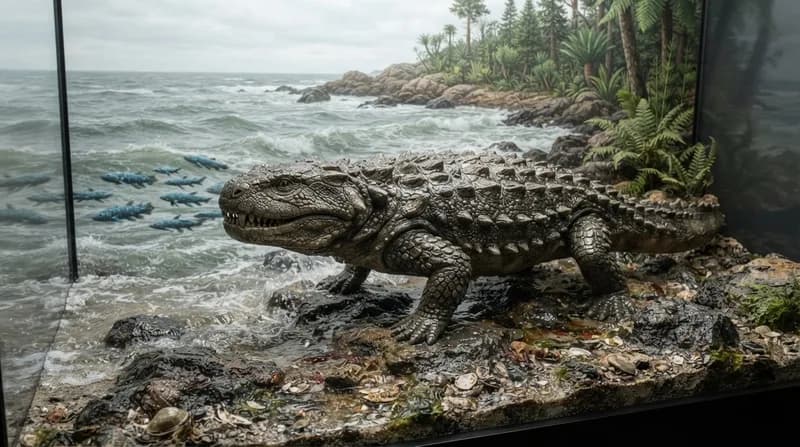
Physically, Gerrothorax maritimus looked nothing like the delicate, slender amphibians we recognize today. Roughly the size of a giant salamander, it sported a broad, flattened, disc-shaped body heavily reinforced with thick, bony armor. This structural shielding likely served as a vital defense mechanism, protecting the creature from the formidable marine predators, such as ichthyosaurs, that prowled the Triassic oceans.
Its hunting strategy was as distinct as its anatomy. Researchers believe the creature functioned as a sedentary ambush predator, much like the modern-day wobbegong shark. Rather than wasting energy chasing prey, the amphibian would lie motionless on the seafloor, camouflaged by its flattened profile, before using a powerful suction mechanism to draw unsuspecting fish and crustaceans into its maw.
Defying the Salt Barrier
The most significant scientific question posed by the fossil is how the creature managed to overcome the lethal physiological challenges that salt water presents to amphibians. Modern amphibians rely on thin, permeable skin for respiration and hydration, which essentially causes them to lose vital internal moisture when exposed to salt, making marine environments a death sentence.
The research team proposes that Gerrothorax maritimus solved this through its unique evolutionary adaptations. Its heavy, bony armor likely acted as a barrier, significantly reducing skin permeability and moisture loss. Instead of relying on its skin, it likely absorbed water through its digestive tract. Furthermore, evidence suggests that the creature possessed functional gills, similar to those found in ancestral fish species, allowing it to efficiently excrete excess salt and maintain internal homeostasis. This combination of structural armor and internal salt regulation allowed it to exploit an ecological niche that has remained strictly closed to all amphibians since the end of the Triassic period.
Verification Through Geological Chemistry
To confirm that these specimens were truly marine-dwellers rather than freshwater visitors washed out to sea, the research team conducted a chemical analysis of the fossils. By measuring the ratios of strontium isotopes within the skeletal remains, they were able to match the chemical signature to that of oceanic water from the Late Triassic. When combined with the high level of skeletal completeness—which indicates the animals died and settled in their natural habitat rather than being transported by currents—the evidence becomes nearly irrefutable. This discovery proves that the evolutionary history of amphibians is far more diverse and experimental than once believed, highlighting a forgotten era when one ambitious group of creatures successfully conquered the vast, salty expanse of the world's oceans.