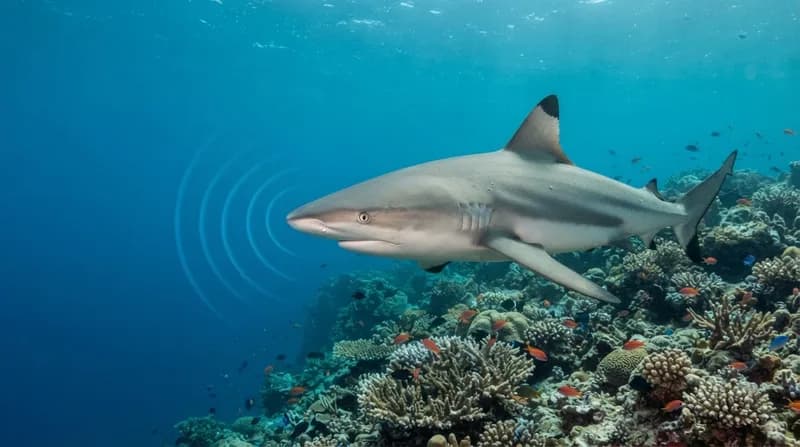
A New Frontier in Marine Bioacoustics
For decades, the sensory capabilities of sharks have been the subject of marine mystery. While we have long understood their reliance on smell and electroreception, their auditory perception remained largely shrouded in uncertainty. A landmark study conducted by researchers at Florida Atlantic University (FAU) has finally peeled back the curtain on this hidden sense, confirming that wild blacktip sharks possess an impressive ability to hear—and accurately localize—sounds from nearly 250 feet away.
Published in the journal Integrative Organismal Biology, the research team utilized a unique combination of drone surveillance and underwater acoustic projection to monitor free-swimming sharks off the coast of Palm Beach County, Florida. Unlike previous laboratory experiments, which often suffer from sound reverberations in small tanks, this field study observed sharks in their natural environment, providing the first quantified evidence that these apex predators can detect and orient themselves toward sound sources in the acoustic far field.
The Methodology of Sound
To ensure the validity of their findings, the researchers employed a rigorous testing protocol. They deployed an underwater speaker that drifted with the current to minimize the influence of the research vessel on the sharks' behavior. The team broadcast a series of low-frequency sounds, ranging from 100 to 800 Hertz, while using a 10 kiloHertz tone as a control variable. Because the 10 kiloHertz frequency falls outside the established hearing range for these sharks, the lack of response to this specific tone confirmed that the observed behavioral shifts were indeed reactions to the lower-frequency acoustic stimuli.
The results were striking: the blacktip sharks displayed a clear "startle response" and performed rapid, deliberate turns to move away from the source of the low-frequency noise. This directional movement indicates that the sharks were not merely sensing an ambient increase in volume; they were actively triangulating the origin of the disturbance. By utilizing calibrated hydrophones and aerial drone footage, the researchers were able to confirm these reactions occurred at distances up to 74 meters—approximately 243 feet.
Why it Matters
This discovery challenges long-held assumptions about how sharks perceive their world. Because sharks lack the gas-filled swim bladder found in bony fish—an organ typically used to amplify sound—scientists previously struggled to explain how they detect pressure waves at such distances. The research suggests that sharks rely heavily on their inner ear structures, specifically the macula neglecta, to detect the particle motion and vibrations associated with sound traveling through water.
- Enhanced Sensory Mapping: The ability to hear from 250 feet away allows sharks to detect prey or threats long before they enter the visual field.
- Far-Field Sensitivity: The study proves that sharks are responsive to sound even in the "far field," where sound behaves differently than in the immediate vicinity of a source.
- Ecological Context: Understanding how anthropogenic noise impacts shark movement is critical for conservation, especially as ocean noise levels continue to rise.
Implications for Marine Science
The success of the FAU team’s methodology highlights the necessity of conducting behavioral research in open-ocean environments. Laboratory settings often create "acoustic mirrors" where sound bounces off walls, resulting in data that may not accurately reflect how an animal behaves in the wild. By moving the laboratory to the ocean, the team has set a new standard for how we study the sensory lives of marine life. Moving forward, the research team intends to further investigate the mechanisms behind this auditory processing, potentially uncovering how sharks filter and prioritize this rich stream of acoustic data to navigate their underwater ecosystems.