A Rare Window Into Ancient Biology
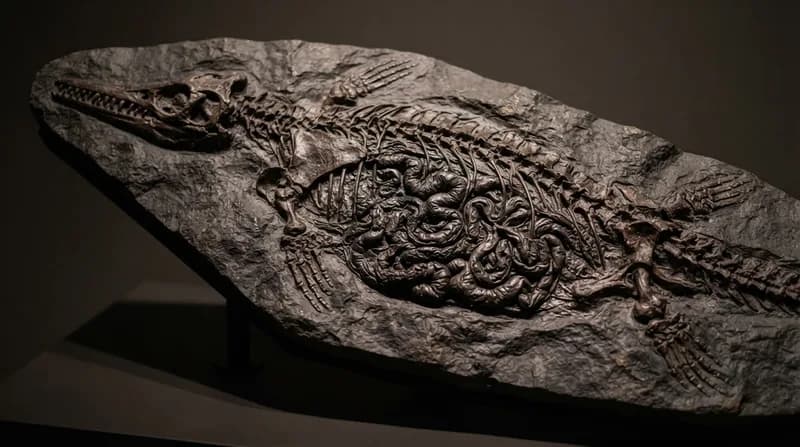
In a groundbreaking discovery that has captured the attention of the global paleontological community, researchers have identified the oldest known, largely complete reptile digestive system. The specimen, an ancient marine reptile known as Austronaga minuta, dates back approximately 245 million years to the Middle Triassic period. Discovered in China, the fossil offers an unprecedented look at the internal anatomy of creatures that navigated the seas long before the reign of the giant mosasaurs.
While fossils of skeletal structures are relatively common, the preservation of soft tissue is an exceedingly rare event, often requiring specific geological conditions to prevent decomposition. This particular specimen preserved not only the creature's bones but also distinct traces of its liver, stomach, and intestines, providing a biological 'snapshot' of how these early aquatic swimmers processed their meals.
The Anatomy of Austronaga minuta
Austronaga minuta was a compact creature, measuring roughly 60 centimeters in length. Despite its small stature, it was highly specialized for an aquatic lifestyle. Its body plan featured a significantly elongated neck and tail, with the tail likely serving as the primary source of propulsion, while its robust front limbs acted as steering stabilizers. Interestingly, its smaller hind limbs played a negligible role in locomotion, marking a clear divergence from its terrestrial archosaur relatives.
The study, published in Science Advances, utilized advanced analytical techniques including UV light photography and mass spectrometry to distinguish the organs from the surrounding rock matrix. These methods revealed a surprisingly simplistic digestive layout. While modern archosaur descendants, such as crocodiles and birds, possess complex, two-part stomachs, Austronaga featured a singular, sac-like stomach chamber. This suggests that the evolutionary path toward complex gastric systems was a later development, as this ancient swimmer utilized a straightforward digestive tract likely optimized for a diet of fish.
Why It Matters
- Evolutionary Timeline: It challenges the long-held belief that early archosaur adaptations to aquatic environments were limited in scope.
- Soft Tissue Preservation: The discovery demonstrates that under the right conditions, organ systems can survive for hundreds of millions of years, opening new doors for paleobiological research.
- Developmental Insight: The simple, single-chambered stomach provides a clear ancestral baseline, showing how gastric systems evolved from basic tubes into the specialized organs found in modern apex predators.
Implications for Future Research
The discovery of Austronaga minuta serves as a vital data point in understanding the transition of reptiles from land to sea. The presence of identifiable hemoglobin traces in the fossilized liver suggests that scientists are entering a new era where we can analyze the chemical composition of ancient creatures, not just their physical shapes.
As research continues, this fossil will remain a cornerstone for investigators studying the diversity of Triassic seas. By bridging the gap between terrestrial archosaurs and specialized marine reptiles, Austronaga provides a compelling narrative of evolutionary agility. It reminds us that even 245 million years ago, life was experimenting with complex survival strategies, finding ways to master the oceans long before the better-known reptiles of the Jurassic and Cretaceous periods took center stage.