The Production Bottleneck
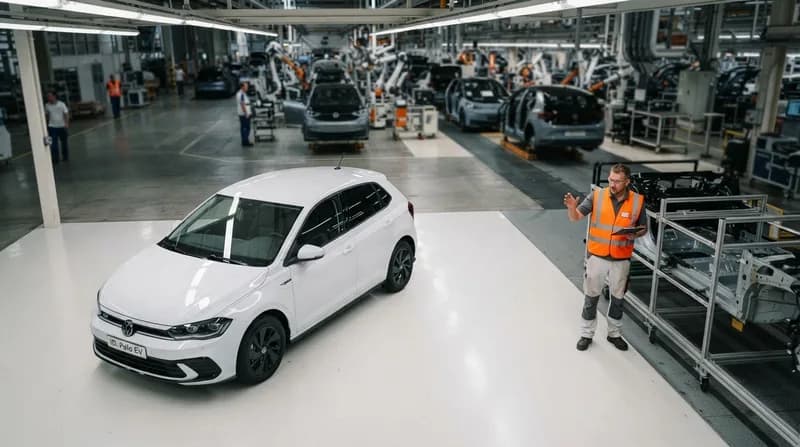
Volkswagen finds itself in the enviable yet difficult position of dealing with a massive surge in demand for its new electric compact vehicle lineup. The VW ID. Polo, intended to be a flagship for accessible electric mobility, has seen its order books swell far beyond the company’s original projections. By the close of September, the automaker had already secured over 53,000 orders for the model, a number that has continued to climb steadily. This overwhelming popularity has triggered significant logistical hurdles at the Martorell plant in Spain, where the ID. Polo shares an assembly line with the Cupra Raval.
Current estimates for delivery are testing customer patience, with some buyers facing wait times exceeding 12 months. Interestingly, the delay is unevenly distributed across the lineup; entry-level 'Trend' trims can experience wait times of up to 21 months, while higher-spec 'Sportline' or 'GTI' versions are currently arriving in significantly shorter windows. Volkswagen attributes these delays to a mismatch between long-term capacity planning and the unexpectedly dynamic nature of consumer demand, noting that production scaling cannot be adjusted with the same speed as current market trends.
The Battery Supply Crunch
The manufacturing challenges extend beyond general assembly capacity; the global shortage of battery cells has become a critical pressure point. Despite the Martorell facility’s ability to assemble up to 1,200 battery systems per day, it remains heavily dependent on external suppliers for the core cells. Recent supply chain disruptions, including reports of issues transporting cells from international sources, have forced temporary production halts, resulting in the loss of nearly 2,000 potential vehicles in recent weeks.
Relief from Volkswagen's internal battery subsidiary, PowerCo, is on the horizon but remains months away. While the new gigafactory in Sagunto is beginning its preliminary phases, high-volume series production is not anticipated until the first half of 2027. Until then, Volkswagen must navigate a delicate balancing act, managing labor shifts—including the hiring of nearly 1,000 additional workers—and stabilizing logistics to ensure that the assembly lines can reach their projected goal of 1,200 vehicles per day.
Broader Challenges for the Electric Urban Car Family
The supply strain is not limited to the ID. Polo; the entire 'Electric Urban Car Family'—comprising the ID. Polo, Cupra Raval, VW ID. Cross, and Škoda Epiq—has surpassed 150,000 total orders. The Škoda Epiq, in particular, is facing its own set of delays, with some German markets seeing wait times as long as 17 months. Because these models share lines with established internal combustion vehicles, expanding output involves complex strategic decisions regarding factory utilization and potential capital-intensive retooling.
Why it Matters
The current situation highlights the inherent risks of the automotive industry's rapid shift toward electrification. As EV market share continues to climb—recently reaching 37% in Germany—manufacturers are finding that legacy production models and supply chain infrastructures are struggling to keep pace. For consumers, the shift means a frustrating period of transition where, despite the availability of compelling electric options, the physical reality of limited battery supply and assembly capacity creates a gap between intent and ownership.