Revolutionizing Fuel Cell Architecture
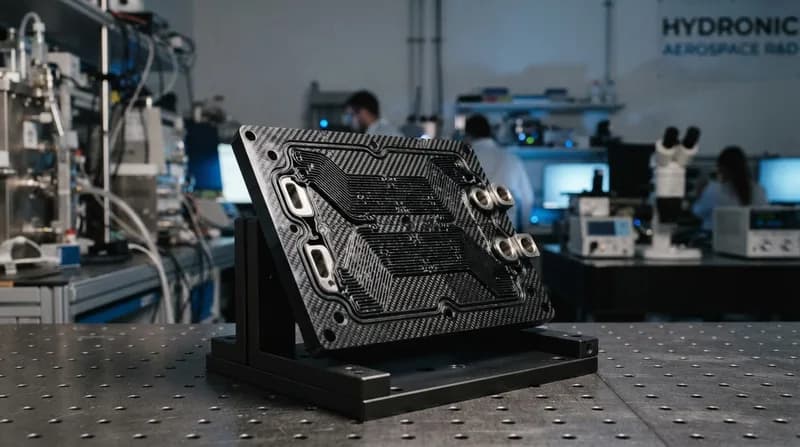
In the pursuit of cleaner, more efficient flight, weight is the ultimate enemy. As the aerospace industry looks toward hydrogen-powered electric aviation, the Fraunhofer Institute for Machine Tools and Forming Technology (IWU) has introduced a promising solution: lightweight, carbon fiber-reinforced plastic (CFRP) bipolar plates. The project, titled StruBiPlate, aims to overcome the significant weight constraints of traditional metallic and graphite components, paving the way for more compact fuel cell stacks in drones and helicopters.
Bipolar plates are the unsung heroes of fuel cells, tasked with gas distribution, electrical connectivity, and thermal management. Historically, engineers have leaned on graphite—which requires thick walls for structural integrity—or metal, which, while robust, adds substantial heft. The StruBiPlate research team sought to leverage the high strength-to-weight ratio of CFRP, an material that also offers customizable thermal and structural properties through precise fiber orientation.
The Hybrid Manufacturing Approach
Initial attempts to emboss channel structures directly into the CFRP proved difficult, as formability limitations arose when channels were oriented perpendicular to the carbon fibers. Undeterred, the team pivoted to a sophisticated hybrid methodology. By bonding a flat CFRP base plate with a laser-structured stainless steel layer, the researchers created a composite that marries the structural benefits of composites with the functional precision of metal flow fields.
The process involves treating the metal surface with lasers to increase its roughness by six-fold, significantly enhancing the mechanical bond with the CFRP layer. To further push the limits of material science, the researchers also experimented with direct structuring of cured CFRP using ultrashort pulse lasers. This advanced technique achieved remarkable precision, keeping the flow field deviations to within 0.01 millimeters of the original CAD design.
Why It Matters
- Weight Reduction: By replacing heavy metallic or graphite plates, the overall system footprint in electric aircraft can be significantly minimized, extending flight range and payload capacity.
- Corrosion Resistance: Using specialized copper-nickel coatings, the team demonstrated corrosion levels comparable to titanium, suggesting high durability.
- Modular Versatility: The ability to combine metal and CFRP offers a flexible path for future hardware design, allowing engineers to balance conductivity with structural rigidity.
Path to Commercialization
The project, which included collaboration with partners like Connova Deutschland and Sächsische Walzengravur, has successfully produced functional demonstrators capable of holding 1.4 bars of pressure in leak tests. However, the path to mass production remains a work in progress. Current laser processing times are measured in hours per flow field, and long-term durability testing of the integrated seals and material bonds must be finalized.
As Fraunhofer continues to scale its hydrogen research—evidenced by the recent opening of the Centre for Energy Storage and Systems in Braunschweig—these CFRP plates represent a vital step toward practical, flight-capable hydrogen propulsion. While these components are currently in the experimental phase, they offer a blueprint for a future where hydrogen mobility is not just feasible, but remarkably lightweight.