E-BUZZ ME Logo
ScienceTechnical Deep Dive

Unlocking Quantum Fluid: How Particle Collisions Condense Light in Semiconductors

Published
Unlocking Quantum Fluid: How Particle Collisions Condense Light in Semiconductors
1 min read172 words

The Gist

New research reveals the mechanics behind light behaving as a quantum fluid in solid-state devices, paving the way for advanced quantum light sources.

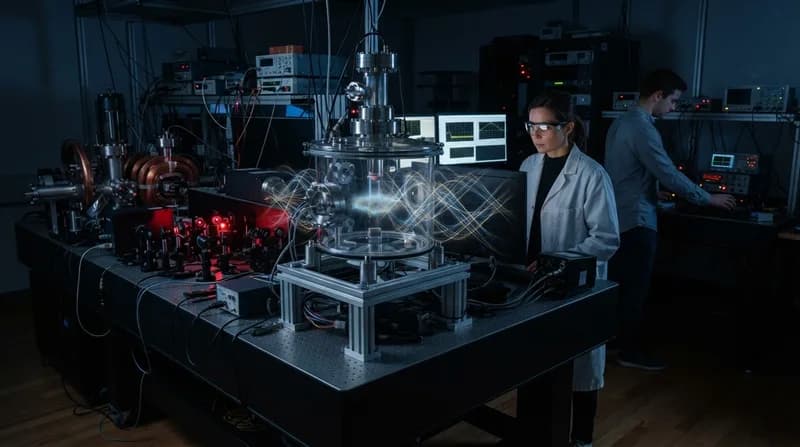
Recent breakthroughs in semiconductor research have provided a clearer understanding of how light can be manipulated to behave like a quantum fluid within solid-state devices. By examining the interaction between photons and matter, researchers have identified the specific role that particle collisions play in the condensation of light.

The Role of Collisions in Light Condensation

In specialized semiconductor structures, photons can become strongly coupled with electronic excitations, creating hybrid particles known as polaritons. The study explains that frequent collisions between these particles allow them to lose energy and settle into a single quantum state, a process known as Bose-Einstein condensation. This transition allows light to flow without friction, exhibiting superfluid properties.

Future Implications for Quantum Technology

This discovery is more than a theoretical milestone; it has practical implications for the development of next-generation quantum technologies. By mastering the conditions under which light condenses in solid-state environments, scientists can develop more efficient and stable quantum light sources. These sources are essential for the future of quantum computing, secure communications, and high-precision sensing applications.

Related Stories

Semantically matched articles, ranked by topic overlap and freshness.

Exotic Particle Physics Simulated via Simple Electronic Circuit
Science75%

Exotic Particle Physics Simulated via Simple Electronic Circuit

Researchers have successfully engineered an electronic circuit capable of mimicking complex symmetries typically reserved for the realm of high-energy particle physics.

Scottish Startup Quantcore Secures Prestigious IOP qBIG Prize
Science75%

Scottish Startup Quantcore Secures Prestigious IOP qBIG Prize

Quantcore, a Glasgow-based quantum technology firm, has been recognized by the Institute of Physics for its innovative superconducting processors and sensors.

Laser-Driven Rotation Unlocks High-Resolution 3D Microscopy for Delicate Samples
Science73%

Laser-Driven Rotation Unlocks High-Resolution 3D Microscopy for Delicate Samples

A new contact-free method uses laser-driven thermoviscous flows to rotate and stabilize biological cells, allowing for unprecedented 3D imaging precision.

From Soviet Physics to Martian Neighbors: Physics World Reviews the Latest Science Books
Science69%

From Soviet Physics to Martian Neighbors: Physics World Reviews the Latest Science Books

Physics World editors provide a condensed look at a diverse new collection of science literature covering everything from historical Soviet institutes to dystopian futures.

Venus Flytraps Snap Shut via Rapid Cell-Wall Softening
Science69%

Venus Flytraps Snap Shut via Rapid Cell-Wall Softening

New research debunking old water-transport theories reveals that Venus flytraps use rapid cell-wall softening to snap shut on prey.

AI Data Centers Approach National-Scale Energy Consumption, UN Report Warns
Science68%

AI Data Centers Approach National-Scale Energy Consumption, UN Report Warns

A new United Nations report highlights the surging electricity demands of the AI industry, with data centers now rivaling the energy consumption of entire countries.

Ken’ichi Nomoto and Stanford Woosley Awarded 2026 Shaw Prize in Astronomy
Science67%

Ken’ichi Nomoto and Stanford Woosley Awarded 2026 Shaw Prize in Astronomy

Astrophysicists Ken’ichi Nomoto and Stanford Woosley have been named joint winners of the 2026 Shaw Prize for their transformative research into stellar explosions.

Study Highlights Material Limits in Spain’s Shift to Renewable Energy
Science67%

Study Highlights Material Limits in Spain’s Shift to Renewable Energy

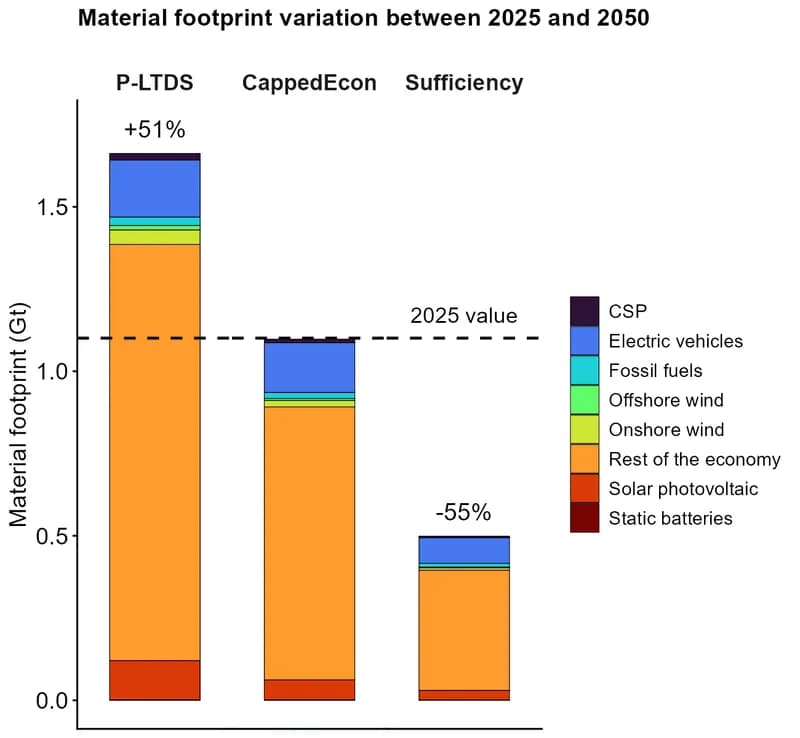
New research suggests that Spain's rapid expansion of renewable energy is only sustainable if accompanied by a significant reduction in overall material and energy demand.