ScienceTechnical Deep Dive

Century-Old Quantum Prediction Finally Observed in Lab

Published
EElectricBuzz Editorial Team
Century-Old Quantum Prediction Finally Observed in Lab
3 min read459 wordsElectricBuzz Editorial Team

The Gist

“Physicists have successfully created 'Bethe strings' in an ultracold gas, confirming a 1931 theoretical prediction and opening new frontiers for quantum research.”

The Emergence of Bethe Strings

In a milestone for theoretical physics, a 95-year-old prediction made by Nobel laureate Hans Bethe has been confirmed. Researchers at the University of Innsbruck have successfully created and observed quantum structures known as “Bethe strings.” These exotic states of matter, which were previously purely mathematical constructs, demonstrate a unique way that particles can bind together in a one-dimensional environment without relying on standard chemical bonding.

Unlike traditional molecules held together by covalent or ionic forces, Bethe strings form due to the intricate quantum interactions between particles constrained to a single dimension. In this study, the research team managed to create clusters containing six or more atoms. These clusters are highly resilient, capable of colliding with one another without breaking apart, a trait that sets them apart from the fragile nature of most conventional particle groupings.

The Experimental Setup: Near Absolute Zero

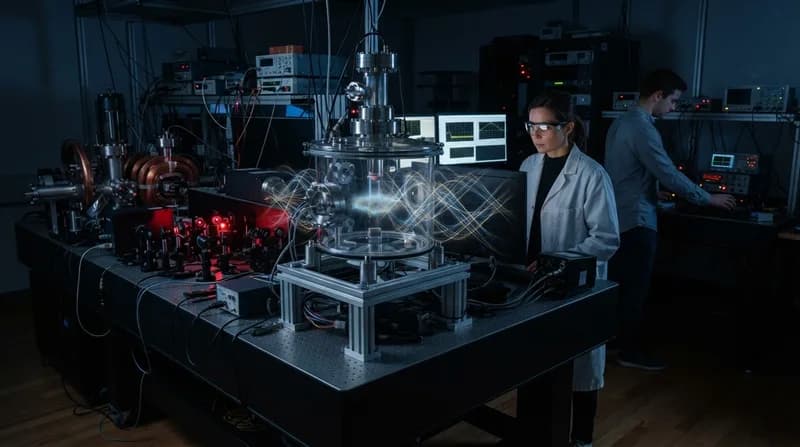
To realize these elusive quantum states, the team utilized a sample of cesium atoms cooled to within mere billionths of a degree above absolute zero. This extreme cold is necessary to minimize thermal interference and allow the quantum properties of the atoms to dominate. The atoms were then trapped within thousands of microscopic, one-dimensional tubes, creating the strictly constrained geometry required for the strings to take form.

By finely adjusting the atomic interactions from repulsive to attractive, the scientists forced the atoms to congregate into these bound states. The ability to manipulate the density, interaction strength, and geometry of the system provides a unprecedented level of control, turning the experimental apparatus into a highly versatile laboratory for studying quantum many-body physics.

Probing Stability Through Collision

A crucial component of the study was verifying the stability of these strings. The researchers observed how the strings expanded within their 1D confinement, noting that the structures remained intact even after undergoing collisions. To further confirm their nature, the team conducted a second experiment where the 1D confinement was removed, allowing the atoms to expand into three-dimensional space.

Because Bethe strings are fundamentally one-dimensional, they disintegrated immediately upon release into the 3D environment. This destruction released a measurable amount of extra energy, which researchers used as a 'smoking gun' to identify the strings' presence. By comparing the energy dynamics of these two expansion states, the team provided concrete evidence that the observed phenomena were indeed the Bethe strings theorized in 1931.

Why It Matters

  • Theoretical Validation: Confirms a cornerstone concept in quantum many-body physics that has stood for nearly a century.
  • New Research Platform: Provides a flexible, controllable environment to study complex quantum states that were previously only observable in specific magnetic systems.
  • Material Insight: Enhances our fundamental understanding of how matter behaves under extreme confinement and ultra-low temperatures, potentially informing future quantum computing and sensor technologies.

SPONSORED
The 5 Best Over-Ear ANC Headphones of 2026, Tested & Ranked
Editor's Pick Guide
92/100
Tech & Gadgets•12 min read

The 5 Best Over-Ear ANC Headphones of 2026, Tested & Ranked

We locked five over-ear ANC picks for 2026 — Sony WH-1000XM6, Bose QuietComfort Ultra 2, Soundcore Space One, Sennheiser Momentum 5, and Apple AirPods Max 2 — then stress-tested them on lab metrics, long-term owner truth, and live street prices.

Related Stories

Semantically matched articles, ranked by topic overlap and freshness.

Could Virtual Reality Be the Secret to Preventing Postpartum Depression?
Science

Could Virtual Reality Be the Secret to Preventing Postpartum Depression?

New research suggests that prenatal VR training sessions may significantly reduce the risk of postpartum depression, particularly for women who have previously given birth.

Cosmic Spectacles: The Four Must-See Celestial Events of October
Science

Cosmic Spectacles: The Four Must-See Celestial Events of October

From the vanishing act of Jupiter to the debris of Halley’s Comet lighting up the night, NASA outlines a packed schedule for October stargazing.

New Stepped Care Model Shows Promise for Accessible PTSD Therapy
Science

New Stepped Care Model Shows Promise for Accessible PTSD Therapy

Flinders University researchers have evaluated a novel, cost-effective digital approach to treating PTSD, balancing clinical efficacy with the growing demand for scalable mental health solutions.

New Global Review Finds Nicotine E-Cigarettes Outperform Traditional Cessation Tools
Science

New Global Review Finds Nicotine E-Cigarettes Outperform Traditional Cessation Tools

A massive analysis of nearly 30,000 participants suggests that regulated nicotine vaping devices are more effective at helping smokers quit than conventional methods like patches and gum.

Natural Compounds Show Promise in Selectively Targeting Cancer Cell Metabolism
Science

Natural Compounds Show Promise in Selectively Targeting Cancer Cell Metabolism

A recent study from Wroclaw Medical University identifies curcumin as a standout candidate in the effort to disrupt cancer cell energy production while sparing healthy tissue.

Why High-Intensity Training Is a Secret Weapon for Healthy Aging
Science

Why High-Intensity Training Is a Secret Weapon for Healthy Aging

A groundbreaking study reveals that for older adults, the secret to shedding fat while preserving vital muscle mass may lie in short, intense bursts of exercise.

Bacterial Immune Systems Reveal a Hidden 'Trojan Horse' Defense Mechanism
Science

Bacterial Immune Systems Reveal a Hidden 'Trojan Horse' Defense Mechanism

A groundbreaking discovery at the University of Utah reveals how bacteria use a virus's own proteins as a tripwire to trigger a lethal, self-sacrificing immune response.

Beyond the Final Product: Scientists Uncover 'Hidden' Materials for a Green Energy Revolution
Science

Beyond the Final Product: Scientists Uncover 'Hidden' Materials for a Green Energy Revolution

Researchers have discovered a new way to identify previously unknown materials by examining the 'in-between' phases of chemical synthesis, potentially unlocking breakthroughs for batteries and solar fuels.