A Record-Breaking Cosmic Duo
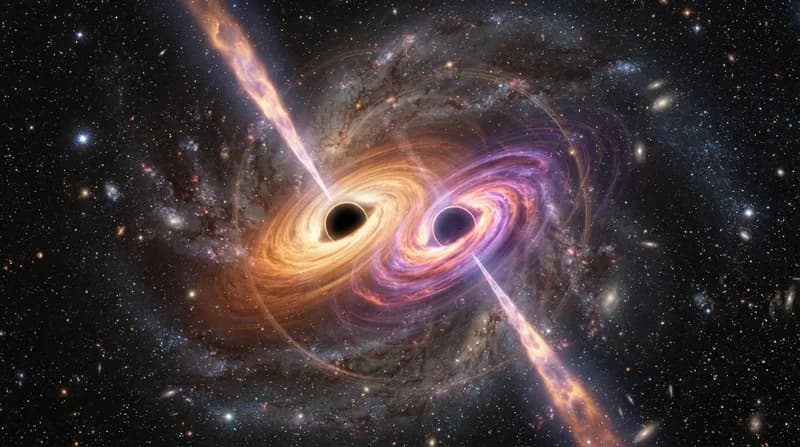
In a groundbreaking discovery that challenges our understanding of the early universe, an international team of astronomers has identified the oldest known compact pair of quasars. Officially designated J1602+4228AB and given the Hawaiian name Nāpōwawāʻenakaulua, this system dates back to just 900 million years after the Big Bang. The discovery offers a rare, high-definition look at the formative years of cosmic history, revealing two supermassive black holes that defy the limits of current evolutionary theory.
The system consists of two distinct black holes, one boasting a mass 1.5 billion times that of our Sun, while its companion weighs in at approximately 400 million solar masses. Separated by only 18,100 light-years—a mere fraction of the diameter of the Milky Way—these giants are positioned closer together than any other known quasar pair from the same epoch. Because they appear so massive so early in the timeline of the universe, they suggest that either our models of black hole formation are incomplete or that the early universe provided conditions for rapid growth that we have yet to fully comprehend.
The Role of Next-Generation Observatories
The identification of Nāpōwawāʻenakaulua was a triumph of multi-instrument collaboration. The initial data was pulled from the Aether survey, a research initiative utilizing the James Webb Space Telescope (JWST) to characterize quasars from the early universe. By analyzing spectra from over 200 quasars, researchers identified the primary candidate, J1602+4228A, and detected a faint, unexpected companion.
To confirm the nature of this object, the team utilized the Gemini North telescope on Maunakea. Despite the immense distance and the inherent difficulty in separating the light of two close-proximity objects, exceptionally sharp atmospheric conditions over the Hawaiian peak allowed the team to gather conclusive data in just two nights. By employing the Gemini Near-Infrared Spectrograph (GNIRS), they were able to distinguish the two quasars individually, confirming that they are separate physical entities rather than a trick of gravitational lensing.
Why It Matters
- Defying Timelines: The existence of billion-solar-mass black holes this early in the universe's life forces scientists to reconsider the speed at which supermassive structures assemble.
- Galactic Laboratories: This system acts as a high-density environment, likely formed by frequent galaxy mergers that accelerated gas accretion and star formation.
- Cultural Connection: The name, chosen through the A Hua He Inoa program, honors the indigenous language of Hawai'i and reflects the immense physical power observed by the international research team.
Implications for Early Galactic Evolution
The discovery of this pair provides a unique laboratory for studying how massive galaxies and their central black holes evolved in tandem. Researchers hypothesize that the region surrounding Nāpōwawāʻenakaulua contained an unusually dense concentration of matter, which facilitated frequent interactions between young galaxies. These collisions would have provided a near-constant supply of gas, fueling the rapid growth of the black holes while simultaneously triggering intense bursts of star formation.
While this interpretation aligns with the observed data, the scientific community remains cautious, continuing to perform gravitational lens modeling to definitively rule out the possibility of light-bending effects. As further data is gathered, this rare cosmic pair will likely serve as a foundational benchmark for future studies regarding the assembly of the universe's first massive structures, proving that even as we look back 13 billion years, the universe still has the power to surprise us.