The Shifting Bottleneck of Progress
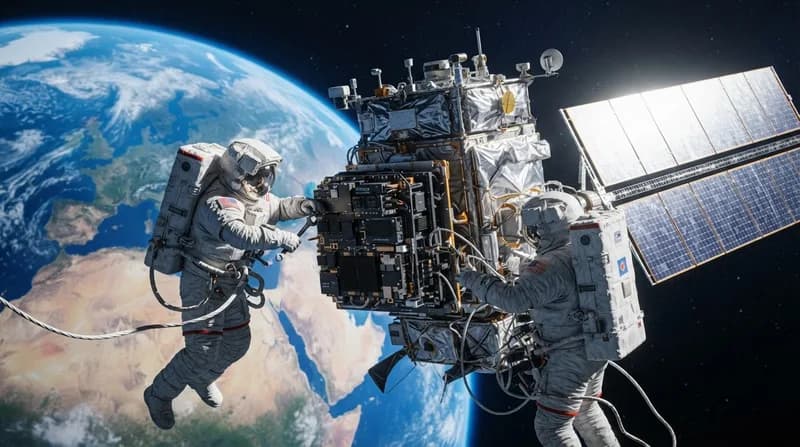
For centuries, human advancement has followed a predictable arc: our intellectual curiosity far outpaces our capacity to execute. While we have peered into the deepest reaches of the cosmos to understand the birth of galaxies, our physical reach remains constrained to our home planet. This gap between the scale of our ambitions and the reality of our logistical capabilities has historically been bridged by building ever-larger bureaucracies. Today, the cost of scientific progress is rising; research productivity has plummeted while the infrastructure required to sustain Moore’s Law or construct instruments like the James Webb Space Telescope requires an unprecedented global workforce.
We have reached a juncture where the primary constraint on human progress is no longer just the lack of ideas, but the scarcity of execution capacity. Every brilliant hypothesis requires evidence, specialized instruments, and a vast support system to bring it to fruition. Economists refer to these inputs as 'complements'—when one improves, the other increases in value. Frontier intelligence is currently meeting this bottleneck, offering the potential to transform how we bridge the distance between a spark of inspiration and a tangible achievement.
The Role of AI as an Execution Engine
AI is emerging as the ultimate force multiplier for the 'uncelebrated intelligence of execution.' By handling the routine, repetitive, and time-consuming tasks that once required entire organizations, AI allows individuals to move from being mere participants in a bureaucracy to active architects of their own creative and scientific visions. Where once a filmmaker needed a massive studio infrastructure to realize a concept, AI lowers the barrier to entry, allowing for a profusion of idiosyncratic projects that were previously silenced by gatekeepers.
However, this is only the initial stage of the Intelligence Age. As AI systems move beyond simply automating labor and begin contributing their own insights—particularly in domains like mathematics—they will shift from being labor providers to agenda setters. This will create a new dynamic where the bottleneck moves from execution capacity to human taste: the ability to determine which questions are worth asking and which of a thousand AI-generated hypotheses deserve the expenditure of scarce real-world resources.
Two Civilizations: Depth Versus Width
The future of this collaboration depends on how humanity chooses to navigate the physical limits of reality. Two potential pathways illustrate this dilemma. The first is a Civilization of Depth, where superintelligence relies on internal reasoning and hyper-efficient simulations to solve problems. By perfecting its internal models, this path minimizes the need for massive, sprawling physical experiments. It views the world through a lens of extreme economy, ensuring that when an experiment is finally performed, it is only because it represents the absolute most efficient way to resolve a specific, high-stakes uncertainty.
The second pathway, a Civilization of Width, embraces the complexity of the physical world. This path assumes that nature's secrets are too vast to be captured by simulation alone and that constant interaction with reality is necessary. In this scenario, AI acts as a orchestrator for an increasingly elaborate network of physical experiments. Whether we head toward depth or width will define the next century of progress. The history of science has been one of increasing scale, but the advent of superior reasoning engines gives us the unique opportunity to optimize our journey, ensuring that our genius is not squandered on the wrong directions or inefficient methods.