Electric VehiclesTechnical Deep Dive

Tesla’s European FSD Ambitions Hit Regulatory Speed Bump

Published
EElectricBuzz Editorial Team
Tesla’s European FSD Ambitions Hit Regulatory Speed Bump
3 min read431 wordsElectricBuzz Editorial Team

The Gist

“A crucial vote on the widespread adoption of Tesla's Full Self-Driving (Supervised) software in the EU has been pushed back, leaving the company's regional rollout in a state of limbo.”

The Path Toward EU-Wide Approval

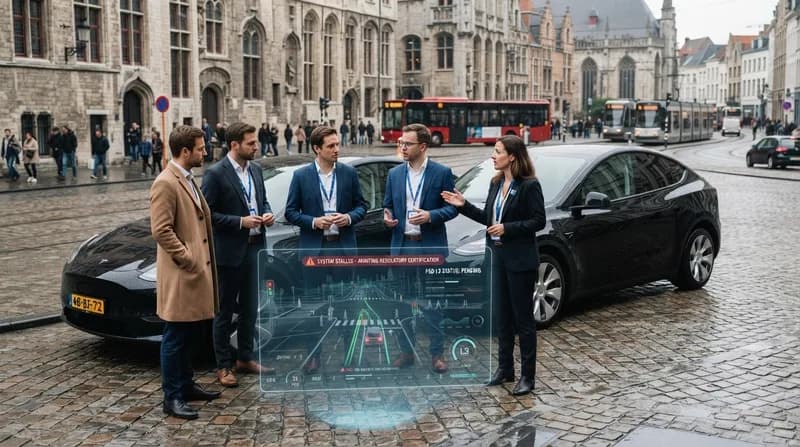
Tesla’s aggressive push to bring its Full Self-Driving (Supervised) system to the European market has encountered a significant bureaucratic delay. Hopes for a comprehensive EU-wide authorization during the upcoming Technical Committee on Motor Vehicles (TCMV) meeting scheduled for October 6 have been dashed. Internal agendas now indicate that the committee will merely hold further discussions on the Netherlands’ provisional approval application, deferring any potential decision to a later date, likely in December at the earliest.

The current legislative landscape relies on Article 39 of EU Regulation 2018/858, a mechanism designed specifically for novel technologies that do not yet fit neatly into existing regulatory frameworks. While the Dutch RDW authority acted as the pioneer by granting provisional approval, the system has since been adopted by seven member states—including Belgium, Denmark, and the Czech Republic. However, these nations represent only a small fraction of the European population, far from the qualified majority required for universal EU deployment.

The Hurdles Facing Autonomy

Securing a broader European green light requires support from at least 15 of the 27 member states, accounting for 65% of the total EU population. As of now, the most influential automotive markets, including Germany, France, Italy, and Spain, have yet to sign off on the system. Regulatory bodies in these regions have voiced specific concerns that go beyond basic software functionality. Key points of contention include the system’s strict adherence to local speed limits and the efficacy of its driver monitoring protocols.

Furthermore, international feedback has been mixed. Sweden, in particular, has reportedly questioned the software’s ability to override speed limits, while other Nordic nations have raised alarms regarding the system’s performance during harsh winter conditions. These safety concerns are coupled with the fundamental distinction that FSD (Supervised) requires constant driver vigilance, a different regulatory category than the fully autonomous systems currently being developed under separate UNECE frameworks.

Why it Matters

The European divide creates a fragmented experience for Tesla owners. While the company reports that FSD (Supervised) is actively used by over 70,000 customers globally and claims its internal safety metrics show a significantly lower accident rate compared to human-driven vehicles, these figures lack independent verification. For Tesla, obtaining a pan-European approval is essential to scale its software ecosystem. Without it, the company remains in a state of regulatory patchwork, unable to fully capitalize on its data-driven growth strategy across the continent. As December approaches, the pressure will be on for Tesla to address the specific compliance concerns of major EU member states if it hopes to move beyond its current limited, nation-by-nation deployment model.

SPONSORED
The 5 Best Over-Ear ANC Headphones of 2026, Tested & Ranked
Editor's Pick Guide
92/100
Tech & Gadgets•12 min read

The 5 Best Over-Ear ANC Headphones of 2026, Tested & Ranked

We locked five over-ear ANC picks for 2026 — Sony WH-1000XM6, Bose QuietComfort Ultra 2, Soundcore Space One, Sennheiser Momentum 5, and Apple AirPods Max 2 — then stress-tested them on lab metrics, long-term owner truth, and live street prices.

Related Stories

Semantically matched articles, ranked by topic overlap and freshness.

New Federal Fuel Economy Rollback Signals Major Shift in U.S. Automotive Policy
Electric Vehicles

New Federal Fuel Economy Rollback Signals Major Shift in U.S. Automotive Policy

The NHTSA has finalized significantly relaxed fuel economy standards, a move projected to increase U.S. gasoline consumption by billions of gallons by 2050.

Cornwall Set to Become a Key Battery-Grade Lithium Hub by 2029
Electric Vehicles

Cornwall Set to Become a Key Battery-Grade Lithium Hub by 2029

Geothermal Engineering Limited has secured government funding to launch a commercial-scale lithium extraction plant in the UK, aiming to bolster domestic EV supply chains.

Bosch Faces Internal Strife as Nuremberg Plant Braces for 900 Job Cuts
Electric Vehicles

Bosch Faces Internal Strife as Nuremberg Plant Braces for 900 Job Cuts

Bosch is set to slash nearly half of its workforce at the Nuremberg facility by 2029, as the company grapples with the transition from internal combustion to electrification.

Pos Malaysia Scales Malaysia’s Largest Electric Logistics Fleet
Electric Vehicles

Pos Malaysia Scales Malaysia’s Largest Electric Logistics Fleet

Pos Malaysia hits a major milestone, with one in three parcels now delivered via electric vehicles as it aggressively targets a fully green fleet by 2030.

Volkswagen Rebrands Electric SUV Lineup as ID. Tiguan
Electric Vehicles

Volkswagen Rebrands Electric SUV Lineup as ID. Tiguan

Volkswagen is officially merging its electric and combustion naming conventions, retiring the ID.4 and ID.5 labels in favor of the iconic Tiguan badge.

Mercedes-Benz Scales Up Thai EV Production With New Electric GLC
Electric Vehicles

Mercedes-Benz Scales Up Thai EV Production With New Electric GLC

Mercedes-Benz is set to localize production of its latest electric GLC in Thailand, targeting the competitive mid-size SUV market with high-end tech and long-range efficiency.

Echion and ETS Forge Strategic Alliance to Accelerate Niobium Battery Production
Electric Vehicles

Echion and ETS Forge Strategic Alliance to Accelerate Niobium Battery Production

UK-based battery innovator Echion Technologies has partnered with South Korean firm Energy Tech Solution to bring its breakthrough niobium-based anode material, XNO, into mass-market cell production.

The Solid-State Revolution: BYD Targets 2025 for Landmark Battery Breakthrough
Electric Vehicles

The Solid-State Revolution: BYD Targets 2025 for Landmark Battery Breakthrough

BYD confirms plans to integrate cutting-edge solid-state battery technology into a production vehicle as early as next year, positioning the automaker at the forefront of the global energy transition.