The Hidden Barrier to Fast Charging
As the electric vehicle industry pushes toward the goal of 'gas-station-speed' charging, researchers have long grappled with the physical limitations of current battery chemistry. A new study from the University of Maryland has identified a critical, previously overlooked phenomenon: the drying out of the positive electrode during high-speed energy transfer.
When a battery charges, lithium ions migrate from the positive to the negative electrode. Crucially, these ions carry solvent molecules along with them. Under standard, slower charging conditions, these solvents flow back into the porous positive electrode, keeping it properly hydrated. However, during the intense influx of energy required for fast charging, the solvent cannot flow back quickly enough. This process, known as electro-osmotic drag, causes the electrode to become depleted or 'dry,' which triggers a sharp drop in charging efficiency.
The Chemistry of Faster Energy Flow
To combat this, the Maryland team experimented with the electrolyte's chemical composition. By incorporating fluorine-containing chemical groups into the solvent molecules, they were able to fundamentally change the way the electrolyte behaves under pressure. This modification reduces the attraction between the lithium ions and the solvent, allowing the solvent to return to the positive terminal with much greater ease.
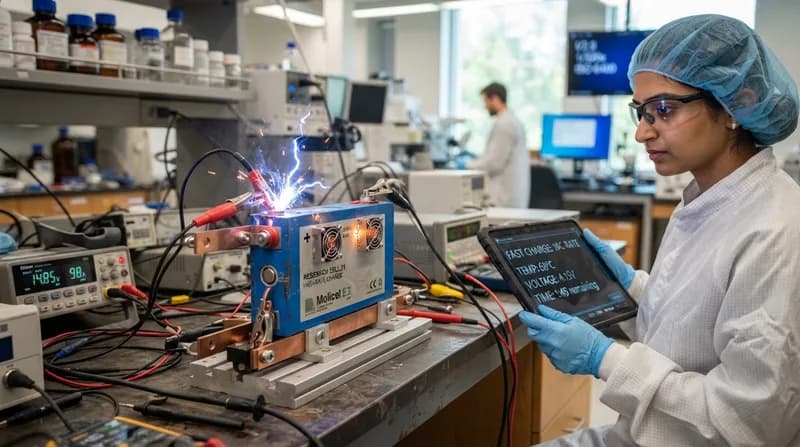
The impact of this adjustment is significant. In testing a 4 Ah pouch cell, the researchers achieved an 80 percent charge in just 12.8 minutes, reaching 90 percent in under 15 minutes. This discovery, detailed in the journal Science, marks a major step forward in understanding the fundamental physics of lithium-ion movement.
Why It Matters
- Overcoming Physical Limits: By identifying 'electro-osmotic drag' in lithium-ion systems, the team has solved a bottleneck that was previously misunderstood or ignored by the industry.
- Performance Gains: The move toward fluorinated solvents allows for significantly faster energy throughput without the rapid degradation often seen in heat-stressed cells.
- Commercial Viability: These findings provide a clear blueprint for battery manufacturers to increase charging speeds without needing to overhaul current manufacturing equipment.
Looking ahead, the researchers are not stopping at the 12-minute mark. Their next objective is to push charge times below the ten-minute threshold. To achieve this, the team plans to pair their modified fluorinated solvent with a proprietary 'adaptive electrolyte.' This next-generation electrolyte is designed to phase-separate, providing specialized protection for both electrodes against the intense stress of high-voltage charging. If successful, this dual-approach could finally deliver the performance levels that EV drivers have been waiting for, turning the dream of true long-distance, quick-charging mobility into a standard feature of modern transport.