The Challenge of Conventional Carbon-Ion Delivery
Carbon-ion radiotherapy has long been recognized for its superior ability to target malignant tumors. Thanks to its sharp Bragg peak—the point where the beam deposits the bulk of its energy—and reduced lateral scattering, it offers a level of precision that traditional proton or photon therapies struggle to match. However, this clinical advantage is hindered by the physical limitations of current delivery systems. Most facilities rely on synchrotron-based pencil-beam scanning, which requires the system to toggle through various beam energies layer-by-layer to cover a three-dimensional tumor volume.
This energy-switching process is time-consuming, with each change adding approximately four seconds of delay. When treating tumors in regions prone to internal motion, such as the lungs or liver, these multi-minute delivery times become a significant liability. The patient's natural breathing cycles can disrupt the beam's path, leading to uncertainties that may distort the radiation dose distribution and impact healthy surrounding tissue. To mitigate these risks, researchers at the GSI Helmholtz Centre for Heavy Ion Research and Technische Hochschule Mittelhessen have engineered a transformative solution.
Introducing the 3D Range Modulator (3DRM)
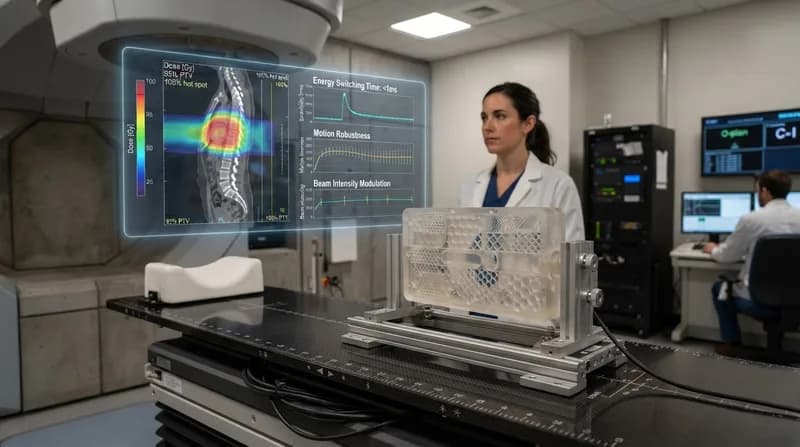
The team’s innovation, detailed in the journal Zeitschrift für Medizinische Physik, centers on a patient-specific 3D range modulator (3DRM). Instead of forcing the synchrotron to adjust its output energy repeatedly, the 3DRM acts as a passive filter. It consists of a meticulously designed array of pins with varying thickness profiles, which shapes the dose and creates a spread-out Bragg peak from a single-energy beam. By standardizing the energy, the system bypasses the need for the synchrotron to reset, effectively collapsing a delivery process that once took minutes into a window of just seconds.
The manufacturing of these modulators requires extreme precision. Each device is 3D-printed with intricate pin structures—some as fine as 100 to 200 micrometers—that are tailored to the specific geometry of a patient's tumor. The workflow integrates seamlessly with the GSI in-house TRiP treatment planning system, which calculates Coulomb scattering effects and converts complex multi-energy plans into single-energy configurations, ensuring the dose remains both accurate and conformal.
Validation and Clinical Outlook
To test the viability of this workflow, the research team conducted a case study using a lung cancer patient profile. They fabricated three distinct 3DRM structures, testing them at varying distances from the target site. The results were highly promising: all configurations achieved excellent target coverage, with over 99% of the target volume receiving at least 95% of the prescribed dose. Crucially, the delivery time was reduced to approximately 30 seconds—a feat that allows for the entire irradiation process to occur within just a few natural breath-holds.
Why It Matters
- Motion Mitigation: By drastically reducing the time required for treatment, the 3DRM minimizes the impact of respiratory-induced motion, ensuring higher dosimetric accuracy for moving targets.
- FLASH Compatibility: The ability to deliver high doses in seconds suggests that this technique could pave the way for FLASH radiotherapy, an emerging ultra-high dose rate treatment that may spare healthy tissue more effectively than conventional methods.
- Workflow Efficiency: Moving away from multi-energy switching streamlines clinical operations, allowing for greater patient throughput and reduced complexity in the radiotherapy control room.
Looking ahead, the researchers note that the 30-second duration is currently limited by the ion supply of the synchrotron rather than the modulator itself. With higher beam intensities, the team believes a treatment field could be delivered in mere seconds, or even within a 150-millisecond pulse. While the integration of these modulators into standard clinical workflows will require updated quality assurance protocols, the ten-year effort to refine 3D-printing precision for these complex components has effectively cleared the path for a new, faster era of particle therapy.