A Rare Glimpse Into the Twilight Zone
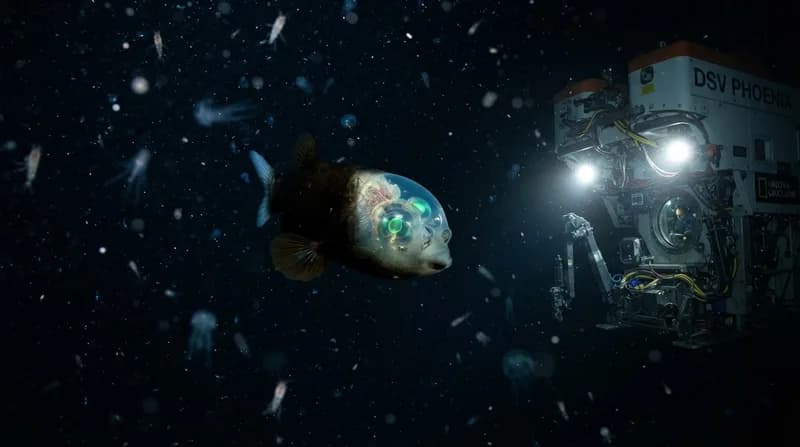
In a rare triumph for deep-sea exploration, researchers from the Monterey Bay Aquarium Research Institute (MBARI) have successfully captured high-definition 4K footage of the elusive barreleye fish (Macropinna microstoma). The encounter took place approximately 2,000 feet below the Pacific Ocean surface during an expedition aboard the research vessel David Packard. Despite nearly four decades of consistent underwater exploration and over 7,000 remotely operated vehicle (ROV) dives, this marks only the eleventh time this mysterious creature has been documented by the institute.
The discovery occurred as the ROV Doc Ricketts was concluding its survey of the ocean's midwater twilight zone. Upon spotting the creature, the research team quickly maneuvered the vehicle to document the specimen, providing a unique look at its physiological adaptations. The footage is not merely a record of a rare animal; it serves as a critical data point for the Biodiversity and Biooptics Team, which has spent years analyzing how deep-sea organisms navigate the extreme pressures and minimal light of the bathypelagic environment.
Anatomy of a Predator: The Rotating Eyes
The barreleye fish is defined by its most striking feature: a transparent, fluid-filled dome that encases its head. Beneath this protective shield lie two highly sensitive, tubular eyes. Unlike most fish, whose eyes are fixed in position, the barreleye can rotate its eyes upward to scan for the silhouettes of prey swimming above it. Once it detects a potential target, the eyes can rotate forward, allowing the fish to track its meal with precision while maneuvering its body to feed.
This sophisticated visual system is an evolutionary response to the dim lighting of the twilight zone, where survival often depends on detecting the most subtle optical cues. The transparent dome is not just a housing for the eyes; it serves a functional role in allowing the fish to feed among the stinging tentacles of siphonophores. By protecting its ocular structures, the barreleye can safely navigate the stinging defenses of its neighbors to steal small crustaceans trapped within them, showcasing a highly specialized niche in the marine food web.
The Importance of Advanced ROV Technology
The success of this mission highlights the evolution of deep-sea observation hardware. By utilizing the 4K cameras and specialized lighting arrays aboard the ROV Doc Ricketts, researchers were able to overcome the challenges posed by the fish's unique anatomy. The ability to manipulate lighting allowed the team to clearly visualize the internal structures of the head shield, which would otherwise be difficult to distinguish in the deep, dark ocean.
Beyond traditional video, the team employed virtual reality 3D stereo imagery during this encounter. This technology provides a spatial perspective of the fish that is invaluable for scientific study and public education. As MBARI continues to utilize its flagship vessel, the David Packard, the integration of these high-fidelity imaging tools promises to unlock further insights into the complex adaptations required for life in the deep ocean, where creatures exist in a constant, delicate balance of survival.