ScienceTechnical Deep Dive

Quiet Revolution: Stanford Researchers Transmit Data Using Thermal Noise

Published
EElectricBuzz Editorial Team
Quiet Revolution: Stanford Researchers Transmit Data Using Thermal Noise
3 min read413 wordsElectricBuzz Editorial Team

The Gist

“Engineers have successfully developed a novel communication system that transmits data using natural thermal noise instead of traditional, energy-hungry radio signals.”

A New Paradigm for Wireless Communication

Researchers at Stanford University have achieved a significant breakthrough in wireless technology by demonstrating a communication system that operates without the need for an actively generated radio signal. By harnessing thermal noise—a phenomenon traditionally viewed as an unwanted nuisance in electronic circuits—the team has successfully transmitted digital information from a transmitter to a receiver. This discovery opens a new frontier for low-power, non-intrusive wireless connectivity.

Thermal noise, specifically Johnson noise, is generated by the random movement of charge carriers within a conductor at temperatures above absolute zero. While typically associated with signal degradation, the Stanford team, led by electrical engineer Zerina Kapetanovic, has flipped this narrative. They utilized the inherent noise found in electrical conductors as the medium for data transmission, effectively proving that what was once a technical hurdle can be turned into a functional signal carrier.

Technical Mechanics and Implementation

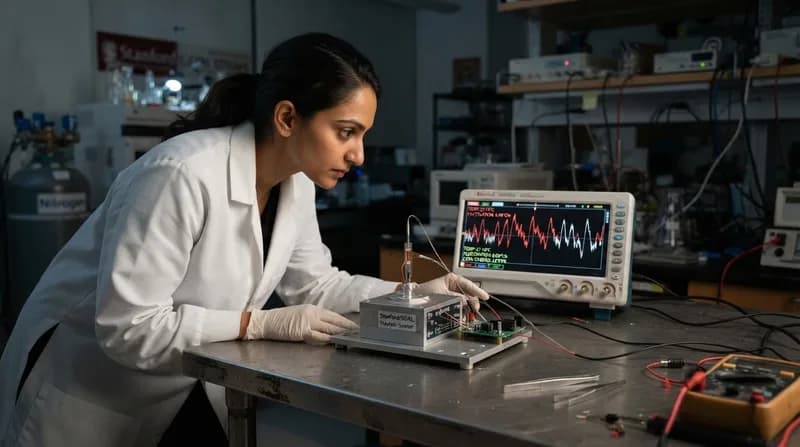
The experimental setup, conducted within a highly insulated anechoic chamber, involved a transmitter equipped with an antenna capable of toggling between two distinct electrical states: an open circuit and a short circuit. These states serve as the binary foundation, representing '1' and '0' respectively. By manipulating the thermal noise reflecting off the antenna, the transmitter can encode data without the need for high-power radio frequency generation.

On the receiving end, the system captures and amplifies the reflected thermal noise, allowing for the retrieval of the encoded bits. To bridge the gap between experimental success and practical application, the researchers developed a comprehensive channel model. This framework allowed them to optimize the connection between the transmitter and receiver, resulting in a remarkable 100-fold increase in data transfer rates during their testing phase.

Why It Matters

The implications for this technology are substantial, particularly regarding energy efficiency and spectrum management. Because the system does not utilize traditional radio frequency (RF) bands, it operates entirely outside the range of occupied Wi-Fi or television broadcast signals, potentially solving congestion issues in modern wireless environments.

  • Extreme Efficiency: The thermal noise transmitter requires significantly less power than conventional RF systems—reportedly up to 1,000 times less energy.
  • Spectral Freedom: It does not compete for crowded radio spectrum, making it ideal for specialized environments.
  • Minimal Interference: The system is designed to function with minimal electromagnetic footprint, which is highly advantageous for sensitive locations where electromagnetic interference must be strictly limited.

As the researchers refine this model, the focus will shift toward practical deployment, potentially transforming how low-power, short-range devices communicate in the future.

SPONSORED
The 5 Best Over-Ear ANC Headphones of 2026, Tested & Ranked
Editor's Pick Guide
92/100
Tech & Gadgets•12 min read

The 5 Best Over-Ear ANC Headphones of 2026, Tested & Ranked

We locked five over-ear ANC picks for 2026 — Sony WH-1000XM6, Bose QuietComfort Ultra 2, Soundcore Space One, Sennheiser Momentum 5, and Apple AirPods Max 2 — then stress-tested them on lab metrics, long-term owner truth, and live street prices.

Related Stories

Semantically matched articles, ranked by topic overlap and freshness.

Nature’s Most Asymmetrical Masterpiece: The 6-Million-Year-Old Whale That Defied Evolution
Science

Nature’s Most Asymmetrical Masterpiece: The 6-Million-Year-Old Whale That Defied Evolution

Paleontologists have uncovered a prehistoric pygmy sperm whale with a face so profoundly crooked it challenges everything we know about mammalian anatomy.

AI Breakthrough Turns Implantable Defibrillators into Early Warning Systems
Science

AI Breakthrough Turns Implantable Defibrillators into Early Warning Systems

Researchers have developed an AI-powered model that analyzes subtle electrical signals from heart implants to predict life-threatening arrhythmias months in advance.

Lubdub Moves Wearable ECG Technology from Research Lab to Clinical Trial
Science

Lubdub Moves Wearable ECG Technology from Research Lab to Clinical Trial

A new gel-free, waterproof wearable patch developed by RMIT University spin-off Lubdub aims to streamline cardiac monitoring and bridge the gap between early symptoms and professional diagnosis.

New Metabolic Compound Boosts Fat Burning While Preserving Muscle Mass
Science

New Metabolic Compound Boosts Fat Burning While Preserving Muscle Mass

Researchers at UC Berkeley have discovered a breakthrough compound that increases energy expenditure without the muscle loss often associated with current weight-loss drugs.

Unlocking a New Target: How Brain Development Clues Could Combat Glioblastoma
Science

Unlocking a New Target: How Brain Development Clues Could Combat Glioblastoma

Researchers at Mount Sinai have uncovered a common molecular vulnerability in aggressive brain tumors that mirrors early development, potentially paving the way for revolutionary new therapies.

Silicon Quantum Computing: Precision Engineering at the Atomic Scale
Science

Silicon Quantum Computing: Precision Engineering at the Atomic Scale

Silicon Quantum Computing is revolutionizing the industry by harnessing individual phosphorous atoms to create high-fidelity, scalable quantum processors.

China Prepares for Historic International Mission to Tiangong Space Station
Science

China Prepares for Historic International Mission to Tiangong Space Station

As the Shenzhou-24 mission rolls to the launchpad, China prepares to welcome its first-ever international astronaut to the Tiangong space station.

MIT Engineers Unveil Breakthrough Gel-Free Ultrasound Patch
Science

MIT Engineers Unveil Breakthrough Gel-Free Ultrasound Patch

A revolutionary new 'bottlebrush' polymer material could transform wearable medical imaging by eliminating the need for traditional, messy ultrasound gels.