The Discovery of Atomic-Scale Rails
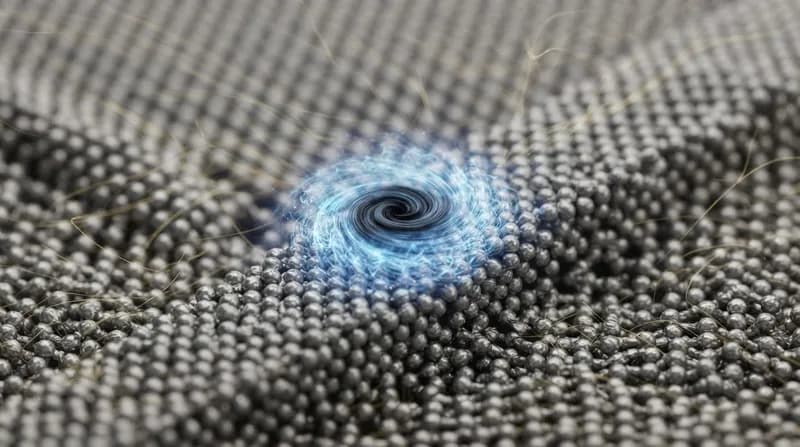
In a significant leap for materials science, a team of researchers from the Research Center for Materials Nanoarchitectonics (MANA) has successfully demonstrated that surface features merely one atom high can act as precision guide rails for quantum vortices. This breakthrough, observed in ultrathin superconductors, provides scientists with a newfound ability to dictate the movement of quantum structures that have historically been difficult to tame. By manipulating these vortices, the team identified a pathway toward superconducting electronics that operate with significantly higher efficiency and lower power consumption.
The study, led by Takashi Uchihashi, utilized scanning tunneling microscopy to observe these vortices in real-time. The researchers discovered that by leveraging these atomic steps, they could force quantum vortices to move more than 1,000 times more easily along the direction of the steps than across them. This anisotropic behavior effectively transforms the material surface into a directional 'quantum highway,' allowing for highly specific control over how charge carriers interact with magnetic fields.
Understanding the Role of Quantum Vortices
To grasp the significance of this discovery, one must understand the nature of superconductors. These materials allow electrical current to flow with zero resistance, but when placed in a magnetic field, the field penetrates the material in the form of quantum vortices. These vortices consist of regions where electrical currents circulate, and their erratic movement often introduces electrical resistance, which degrades the performance of the device.
For decades, controlling the trajectory of these vortices in two-dimensional, atomic-layer superconductors has been a major bottleneck for engineers. The MANA team's discovery that these vortices can be steered along 'atomic rails' offers a solution. Crucially, the researchers found they could tune this guiding effect by adjusting external variables like temperature and magnetic field strength. This level of dynamic control provides a roadmap for developing hardware that is not only faster but also significantly more energy-efficient than current silicon-based technologies.
Why This Matters for Future Tech
- Energy Efficiency: By mitigating the resistance caused by vortex movement, future electronics could theoretically operate with a fraction of the energy consumption seen in today's high-performance hardware.
- Precise Control: The ability to tune vortex movement using temperature and magnetic fields means that future engineers may be able to create 'switches' or 'valves' for quantum information.
- Quantum Tunneling at Scale: The observations also revealed that at lower temperatures, quantum tunneling plays a key role in vortex movement, allowing the structures to bypass energy barriers that would normally trap them.
- Pinning-Free Flow: Within a specific magnetic field range of 0.10 to 0.20 Tesla, the researchers observed a 'pinning-free' flow, enabling vortices to glide across the surface without encountering structural defects.
Looking ahead, this research provides the fundamental groundwork for integrating quantum-scale control into practical circuitry. While the technology is currently in the experimental phase, the ability to direct quantum vortices with such remarkable precision using naturally occurring atomic steps could be the catalyst for a new generation of superconducting processors and energy-transfer systems that were previously relegated to the realm of theoretical physics.