ScienceTechnical Deep Dive

Deciphering the Past: Uranium Cubes Reveal Nazi Nuclear Hurdles

Published
EElectricBuzz Editorial Team
Deciphering the Past: Uranium Cubes Reveal Nazi Nuclear Hurdles
3 min read481 wordsElectricBuzz Editorial Team

The Gist

“New analytical research on surviving uranium artifacts confirms that Nazi Germany's nuclear ambitions were severely crippled by extreme resource shortages and technical limitations.”

The Myth of the Near-Miss

For decades, the narrative surrounding Nazi Germany’s wartime nuclear program has been shrouded in a mix of historical intrigue and scientific speculation. At the center of this mystery was the Uranprojekt, an ambitious effort to harness nuclear fission for strategic advantage. While lead physicist Werner Heisenberg often maintained that his final experimental reactor, the B8 pile, was on the precipice of success, a new study published in PNAS Nexus suggests that this claim was vastly overstated. By analyzing surviving uranium cubes and long-buried archival documents, researchers have definitively concluded that the project was doomed by a severe lack of essential raw materials.

The Criticality Gap

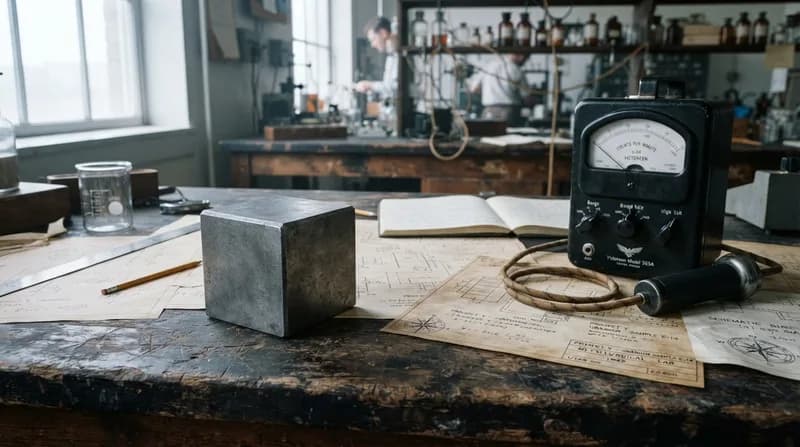
At the core of the investigation are surviving cubes of natural uranium, which served as the fuel source for the B8 reactor. When Allied forces captured the facility in 1945, the experiment had never achieved 'criticality'—the point at which a nuclear chain reaction becomes self-sustaining. Heisenberg claimed that the system needed only a marginal increase in its uranium fuel to tip the scales. However, detailed modern reconstructions tell a different story. Calculations reveal that the B8 reactor would have required nearly double the amount of uranium and over twice the volume of heavy water actually available to the German scientists to achieve a sustained reaction.

The Heavy Water Dilemma

The success of early nuclear experiments was heavily dependent on a moderator to slow down neutrons, facilitating a steady fission chain. Nazi Germany relied exclusively on heavy water, a substance produced at the Norsk Hydro facility in Vemork, Norway. The strategic importance of this site made it a prime target for Allied sabotage and bombing, effectively choking off the German supply chain. Unlike their American counterparts, who utilized purified graphite as a substitute moderator, the German team found themselves at a dead end. Internal analysis of the graphite available to German researchers showed it contained high levels of boron impurities, which acted as a neutron poison, rendering it useless for their reactor designs.

Why It Matters

  • Correction of Historical Record: This research debunking Heisenberg’s post-war claims underscores the vast technological gap between the Manhattan Project and the German Uranprojekt.
  • Nuclear Forensics: The use of 'nuclear archaeology'—analyzing surviving physical artifacts—provides a powerful methodology for verifying technical history that was previously only documented through biased memoirs.
  • Resource Scarcity: The study highlights how critical supply chains—such as the production of heavy water—can serve as the ultimate bottleneck for high-stakes scientific breakthroughs during wartime.

Ultimately, these findings provide a sobering look at how far the Nazi nuclear program remained from reality. The sheer scale of the material shortage indicates that the program was not merely missing a minor component; it was fundamentally hampered by logistical and resource limitations that no amount of theoretical brilliance could overcome. Eight decades later, these unassuming uranium cubes stand as quiet witnesses to the insurmountable divide between ambition and engineering reality.

SPONSORED
The 5 Best Over-Ear ANC Headphones of 2026, Tested & Ranked
Editor's Pick Guide
92/100
Tech & Gadgets•12 min read

The 5 Best Over-Ear ANC Headphones of 2026, Tested & Ranked

We locked five over-ear ANC picks for 2026 — Sony WH-1000XM6, Bose QuietComfort Ultra 2, Soundcore Space One, Sennheiser Momentum 5, and Apple AirPods Max 2 — then stress-tested them on lab metrics, long-term owner truth, and live street prices.

Related Stories

Semantically matched articles, ranked by topic overlap and freshness.

Can Virtual Gardens Cure Nature Deficit? New Research Investigates
Science

Can Virtual Gardens Cure Nature Deficit? New Research Investigates

A groundbreaking study from Drexel University uses virtual reality to reveal how curated ornamental gardens can provide restorative health benefits similar to untouched nature.

USC Breakthrough: Scientists Unlock Renewable Source for Next-Gen Cancer Immunotherapy
Science

USC Breakthrough: Scientists Unlock Renewable Source for Next-Gen Cancer Immunotherapy

Researchers have discovered a method to engineer self-renewing immune cell progenitors, paving the way for scalable, 'off-the-shelf' cancer treatments.

New AI Framework Turns Smartphones Into Pediatric Diagnostic Tools
Science

New AI Framework Turns Smartphones Into Pediatric Diagnostic Tools

Researchers have developed a domain-adaptive deep learning model that enables standard smartphones to detect abnormal lung sounds with clinical-grade accuracy.

Metabolic Mastery: How a Cancer-Fueling Protein Could Turn the Tide on Tumors
Science

Metabolic Mastery: How a Cancer-Fueling Protein Could Turn the Tide on Tumors

Researchers have discovered that by flipping a metabolic switch, a protein once thought to only aid tumor growth can be repurposed to supercharge the immune system.

The Hidden Mental Health Toll of Legalized Sports Betting
Science

The Hidden Mental Health Toll of Legalized Sports Betting

New research from Johns Hopkins University highlights a troubling correlation between the proliferation of online sports betting and rising mental health treatment rates.

The Invisible Battle: How Our Microbial Neighbors Shape Antibiotic Resistance
Science

The Invisible Battle: How Our Microbial Neighbors Shape Antibiotic Resistance

New research from Nairobi reveals that the secret to fighting antibiotic-resistant bacteria may lie not just in medicine, but in protecting the healthy microbial communities we share with those around us.

Could Your Late-Night Snack Be Hurting Your Liver?
Science

Could Your Late-Night Snack Be Hurting Your Liver?

New research from Oregon Health & Science University suggests that the timing of your last meal might be just as important for liver health as the food itself.

Biological Logbooks: New DNA Typewriter Technology Maps How a Single Cell Becomes a Body
Science

Biological Logbooks: New DNA Typewriter Technology Maps How a Single Cell Becomes a Body

Researchers have pioneered a 'DNA Typewriter' that records the developmental history of every cell in a mouse embryo, offering unprecedented insights into human health and disease.