ScienceTechnical Deep Dive

New AI Framework Turns Smartphones Into Pediatric Diagnostic Tools

Published
EElectricBuzz Editorial Team
New AI Framework Turns Smartphones Into Pediatric Diagnostic Tools
3 min read457 wordsElectricBuzz Editorial Team

The Gist

“Researchers have developed a domain-adaptive deep learning model that enables standard smartphones to detect abnormal lung sounds with clinical-grade accuracy.”

Bridging the Diagnostic Gap

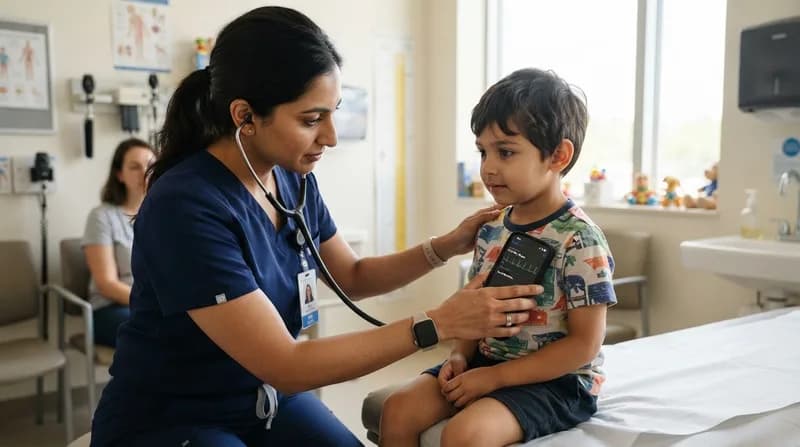
Pediatric respiratory health remains a significant global challenge, often complicated by the limited availability of professional medical equipment in remote or underserved regions. While clinicians rely on electronic stethoscopes for precise auscultation, their cost and the necessity for in-person consultations create barriers to frequent monitoring. A breakthrough from researchers at the Seoul National University of Science and Technology (SeoulTech) is now addressing this by leveraging the one tool almost everyone possesses: the smartphone.

The challenge has never been computing power, but rather data incompatibility. Artificial intelligence models trained on high-fidelity, medically certified electronic stethoscopes frequently fail when applied to smartphone microphones. To a neural network, the subtle variations in how these two devices capture audio are akin to hearing entirely different languages. The research team, led by Associate Professor Seong-Eun Kim, has successfully tackled this domain mismatch, creating a pathway for accessible, at-home respiratory screening.

Technical Innovations in Signal Processing

The core of the team’s success lies in a dual-pronged strategy to align audio data. First, the researchers implemented a preprocessing pipeline that applies a 1 kHz low-pass filter while downsampling audio from 48 kHz to 4 kHz. By narrowing the frequency profile, the smartphone audio is brought into an acoustic range that is functionally compatible with the highly structured data captured by clinical stethoscopes.

Beyond basic filtering, the team developed a sophisticated directional MixStyle module integrated into an Audio Spectrogram Transformer (AST) backbone. This module intelligently injects feature statistics from the smartphone domain into the stethoscope training set. Essentially, the model is trained to interpret the clinical audio through the unique acoustic characteristics of a smartphone, effectively bridging the performance gap that has stalled previous attempts at mobile diagnostic integration.

Key Performance Metrics

  • Primary Set Accuracy: The domain-adapted model achieved an F1 score of 0.802 and an AUROC of 0.911, significantly outperforming naive pooling methods.
  • Generalization: When tested on an independent external cohort of 48 children, the model maintained high efficacy with an F1 score of 0.744 and an AUROC of 0.862.
  • Comparative Benchmarking: In direct trials, the proposed framework surpassed the performance of standard models by a wide margin, proving that simple data aggregation is inferior to deliberate domain adaptation.

Why it Matters

The implications for global health are substantial. This framework serves as a vital proof-of-concept for scalable, cost-effective pediatric monitoring. By enabling parents to screen for abnormal lung sounds in a home environment, the technology could reduce the burden on healthcare facilities and improve early intervention rates for common respiratory illnesses. While the team emphasizes that further real-world validation—including testing across a wider variety of smartphone hardware and larger, diverse patient populations—is necessary, the current results indicate that the barrier between clinical-grade diagnostics and consumer hardware is rapidly disappearing.
SPONSORED
The 5 Best Over-Ear ANC Headphones of 2026, Tested & Ranked
Editor's Pick Guide
92/100
Tech & Gadgets•12 min read

The 5 Best Over-Ear ANC Headphones of 2026, Tested & Ranked

We locked five over-ear ANC picks for 2026 — Sony WH-1000XM6, Bose QuietComfort Ultra 2, Soundcore Space One, Sennheiser Momentum 5, and Apple AirPods Max 2 — then stress-tested them on lab metrics, long-term owner truth, and live street prices.

Related Stories

Semantically matched articles, ranked by topic overlap and freshness.

Can Virtual Gardens Cure Nature Deficit? New Research Investigates
Science

Can Virtual Gardens Cure Nature Deficit? New Research Investigates

A groundbreaking study from Drexel University uses virtual reality to reveal how curated ornamental gardens can provide restorative health benefits similar to untouched nature.

Deciphering the Past: Uranium Cubes Reveal Nazi Nuclear Hurdles
Science

Deciphering the Past: Uranium Cubes Reveal Nazi Nuclear Hurdles

New analytical research on surviving uranium artifacts confirms that Nazi Germany's nuclear ambitions were severely crippled by extreme resource shortages and technical limitations.

USC Breakthrough: Scientists Unlock Renewable Source for Next-Gen Cancer Immunotherapy
Science

USC Breakthrough: Scientists Unlock Renewable Source for Next-Gen Cancer Immunotherapy

Researchers have discovered a method to engineer self-renewing immune cell progenitors, paving the way for scalable, 'off-the-shelf' cancer treatments.

Metabolic Mastery: How a Cancer-Fueling Protein Could Turn the Tide on Tumors
Science

Metabolic Mastery: How a Cancer-Fueling Protein Could Turn the Tide on Tumors

Researchers have discovered that by flipping a metabolic switch, a protein once thought to only aid tumor growth can be repurposed to supercharge the immune system.

The Hidden Mental Health Toll of Legalized Sports Betting
Science

The Hidden Mental Health Toll of Legalized Sports Betting

New research from Johns Hopkins University highlights a troubling correlation between the proliferation of online sports betting and rising mental health treatment rates.

The Invisible Battle: How Our Microbial Neighbors Shape Antibiotic Resistance
Science

The Invisible Battle: How Our Microbial Neighbors Shape Antibiotic Resistance

New research from Nairobi reveals that the secret to fighting antibiotic-resistant bacteria may lie not just in medicine, but in protecting the healthy microbial communities we share with those around us.

Could Your Late-Night Snack Be Hurting Your Liver?
Science

Could Your Late-Night Snack Be Hurting Your Liver?

New research from Oregon Health & Science University suggests that the timing of your last meal might be just as important for liver health as the food itself.

Biological Logbooks: New DNA Typewriter Technology Maps How a Single Cell Becomes a Body
Science

Biological Logbooks: New DNA Typewriter Technology Maps How a Single Cell Becomes a Body

Researchers have pioneered a 'DNA Typewriter' that records the developmental history of every cell in a mouse embryo, offering unprecedented insights into human health and disease.