The Rise of Cellular Cartography
For decades, developmental biology has grappled with a fundamental mystery: how a single, nondescript fertilized egg orchestrates the complex, multi-stage transformation into a fully formed organism. Recently, a team of researchers from the University of Washington School of Medicine and Dartmouth College achieved a breakthrough in mapping this process. By deploying a revolutionary technology known as the 'DNA Typewriter,' scientists have successfully reconstructed the granular family tree of a developing mouse embryo, tracking its lineage from the first two-cell division through to the formation of distinct organs.
This study, published in the journal Science, utilized a sophisticated genetic recording system to monitor the first 13.5 days of mouse embryonic development. Unlike previous methods that relied on observational snapshots or damaging genetic markers, this approach embeds a permanent, chronological record directly into the cellular genome. This 'biological logbook' allows researchers to view not just what a cell is, but exactly where it came from, providing a high-resolution view of the intricate choreography of life.
The DNA Typewriter Mechanism
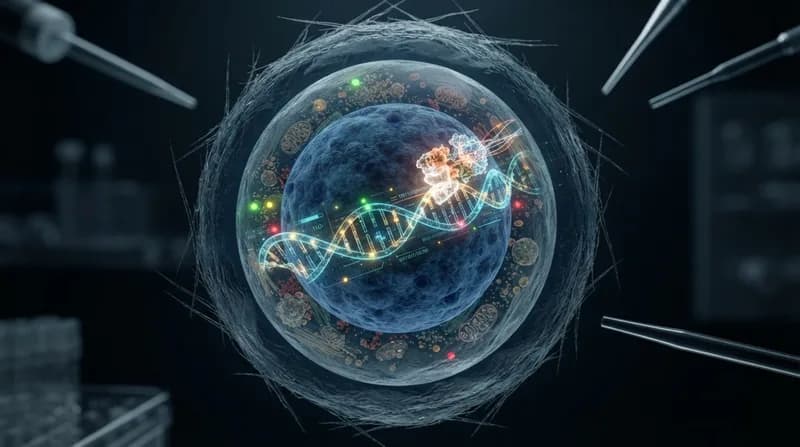
The core innovation behind this research is the DNA Typewriter, a system designed to act as a recording device embedded within the organism's DNA. Researchers inserted a specific recording sequence—a 'tape'—into the genome of a fertilized mouse egg. As the cell divides and grows, the system operates with the precision of a mechanical typewriter, stamping new identifying characters onto the genetic tape with every division.
Crucially, this system preserves the temporal order of events. Because the characters are imprinted sequentially, the system avoids the limitations of older technologies that often required damaging DNA or attempting to reconstruct the order of events retroactively. This enables scientists to track lineage with minimal disruption to the embryo’s natural development, creating a reliable and stable data trail that survives as the cells multiply and specialize.
Why It Matters: Decoding Development and Disease
The implications of this research extend far beyond mouse biology. By understanding how cells commit to their roles—whether becoming part of the nervous system, blood, or retina—scientists are gaining a clearer window into how developmental errors occur. This knowledge is essential for advancing our understanding of several critical health areas:
- Congenital Malformations: Identifying the precise moment cellular development goes off-track could explain how certain birth defects originate.
- Cancer Research: By mapping how cells divide and differentiate, researchers can better understand how abnormal cell growth and failed regulatory mechanisms drive tumor formation.
- Regenerative Medicine: Insights into cellular identity and the timing of specialization provide a blueprint for stem cell engineering, potentially improving therapies that require precise control over cell fates.
- Neurodevelopmental Conditions: The map of cellular ancestry helps clarify the origins of disorders stemming from early developmental instability.
New Insights into Cellular Commitment
One of the most revealing aspects of the study was the observation of cell identity. The researchers discovered that cellular commitment is not a uniform event; rather, different tissue types follow their own specific schedules. While some cell populations committed to their future roles relatively early, others remained in a more flexible, unspecialized state for longer periods. This finding challenges the notion that cellular differentiation is a singular, synchronized event across the entire embryo.
By tracing nearly every profiled cell back to its original ancestor from the very first division, the team could quantify how individual founding cells contribute to the final body structure. They found that while one of the first two cells might contribute more descendants, both founding cells contribute to a remarkably similar diversity of cell types. This discovery provides a foundational template for future experiments, confirming that we can now observe the microscopic decisions that build a macroscopic body in real-time.