The Invisible Influence of Quantum Mechanics
In the strange landscape of quantum physics, particles often defy the intuitive laws of classical mechanics. One of the most famous examples is the Aharonov-Bohm effect, a phenomenon first predicted in 1959. It suggests that a charged particle can be influenced by a magnetic field even if it never enters the region where the field exists. Now, a team of researchers at the University of Oxford has successfully demonstrated this effect using a sophisticated hybrid quantum computer, effectively bringing a decades-old theoretical prediction into a modern, experimental setting.
By constructing a simulated lattice gauge theory, the team was able to observe how a particle's movement through quantum tunneling is suppressed by an invisible magnetic flux. This experiment marks a significant milestone in quantum simulation, proving that hybrid hardware can tackle complex fundamental interactions that remain largely out of reach for classical supercomputers.
How the Hybrid Quantum System Functions
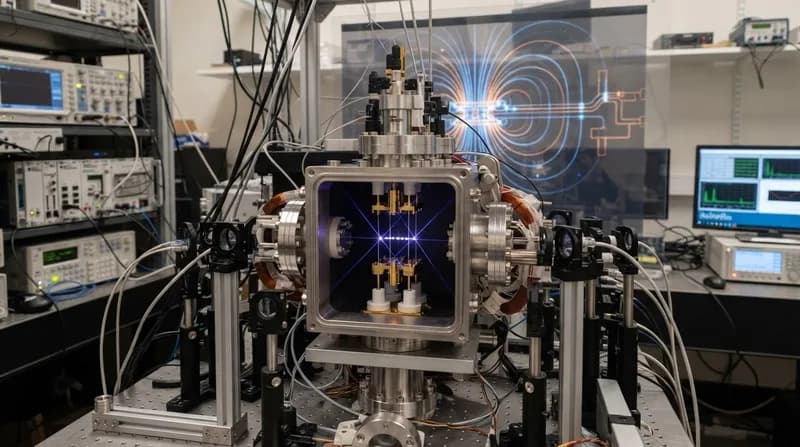
The success of the Oxford team relied on a novel hybrid architecture that blended two distinct quantum components. The setup utilized trapped ions—electrically charged atoms held by electromagnetic fields—to perform dual functions. First, the internal states of these ions served as qubits, representing the gauge fields in the theoretical model. Second, the physical vibrations of these same ions acted as quantum oscillators, which represented the matter being studied.
By weaving these two components together, the researchers created a closed loop that acted as a foundational building block for a lattice gauge theory. This design allowed the magnetic flux to be encoded directly into the qubits rather than being treated as an external, static background condition. As a result, the magnetic field and the matter particle became part of the same evolving quantum dynamic, allowing for a much more nuanced observation of their interaction.
Why It Matters
- Beyond Classical Limits: Traditional computers struggle with the exponential mathematical complexity of lattice gauge theories as they grow, whereas quantum simulators can directly observe these fundamental interactions.
- Dynamical Fields: By encoding magnetic flux into dynamic quantum components, researchers can now study how matter and fields influence one another in real-time, providing a deeper look at the basic forces of the universe.
- Destructive Interference: The experiment demonstrated that when two paths of a particle interfere destructively due to phase shifts caused by the flux, the particle effectively stops moving—a powerful visual demonstration of quantum wave behavior.
Stopping Particles in Their Tracks
The core of the experiment centered on the behavior of a matter particle attempting to "tunnel" between locations. Under standard conditions, the particle could move freely around the simulated loop. However, when the researchers introduced the dynamic magnetic flux, the quantum phase of the particle’s wave function was altered across the two available paths. This phase shift caused the paths to interfere with one another in a way that completely canceled out the movement.
Essentially, the particle was rendered stationary by the magnetic influence, despite the field existing entirely outside of the particle’s path. This groundbreaking result confirms that quantum simulators are becoming essential tools for high-energy physics, enabling scientists to stress-test the laws of nature in a controlled environment. The work, published in Nature Physics, stands as a testament to the growing maturity of hybrid quantum architectures in solving fundamental riddles of the cosmos.