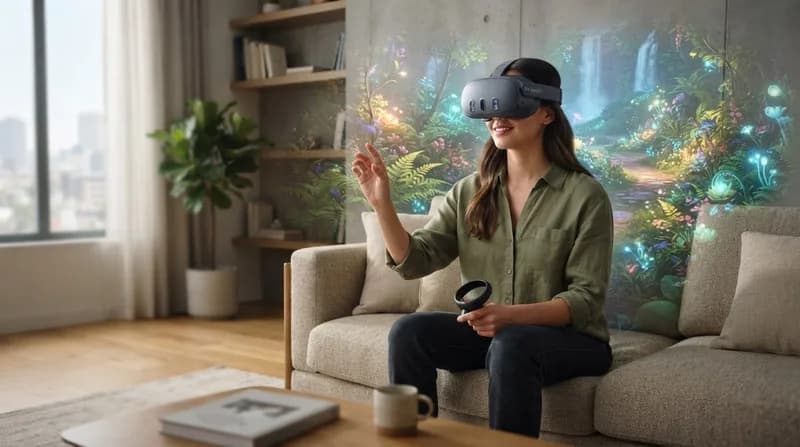
The Science of Virtual Nature
As modern life increasingly traps humans in indoor, windowless environments, the concept of 'nature deficit' has emerged as a significant contributor to chronic stress and cognitive fatigue. A new study from Drexel University’s Nick Howley College of Engineering and Computing explores a high-tech solution: virtual reality (VR) experiences designed to replicate the restorative effects of natural spaces. By leveraging cutting-edge biometric tracking, researchers are beginning to map exactly how our brains and bodies react to different types of environments.
To conduct this research, the team utilized 360-degree immersive VR environments modeled after the real-world landscapes of Longwood Gardens in Pennsylvania. The study followed 32 adult participants as they navigated three distinct virtual conditions: a plain indoor office-like space, highly curated ornamental gardens, and relatively untouched natural landscapes like forests and meadows. During the six-minute immersion for each site, researchers monitored physiological data to capture a nuanced picture of human well-being.
Biometric Insights and The 'Aroused Fascination' Phenomenon
The study’s most striking discovery involves the physiological impact of ornamental gardens. Using functional near-infrared spectroscopy (fNIRS) to track blood oxygenation in the prefrontal cortex, researchers found that these curated spaces reduced cognitive strain to almost the same level as wild, natural environments. Essentially, the 'thinking' part of the brain was able to settle and recover in the ornamental setting, mirroring the restorative effects typically only attributed to untamed nature.
However, the physiological data took a surprising turn when researchers looked at autonomic arousal. While the brain quieted down, skin conductance sensors—which measure nervous system arousal—showed that participants were actually more 'awake' and alert in the ornamental gardens than they were in the wild landscapes or the control office. The research team has dubbed this unique physiological state 'aroused fascination,' a compelling blend of mental restoration and physical engagement that challenges previous assumptions about how built environments influence our health.
Why it Matters: Scaling Mental Well-being
This study serves as a critical proof-of-concept for architects, urban planners, and health professionals looking to design environments that combat mental fatigue. While traditional advice suggests getting outside, logistical barriers like urban density, limited accessibility, and climate issues often make that difficult. The success of this VR experiment suggests that we do not necessarily need to be in 'wild' nature to achieve cognitive restoration.
- Precision Design: Evidence-based design can now prioritize specific visual elements that trigger a 'quiet' brain response.
- Scalable Solutions: VR technology provides a modular, repeatable way to deliver stress-relieving breaks for individuals in high-stress or windowless work environments.
- Beyond Simple Restoration: The discovery of 'aroused fascination' proves that human-designed, ornamental nature is not just a secondary alternative to the wild, but a distinct tool with its own unique psychological and physiological applications.
While the current study focused on sight and sound, the authors acknowledge that future research must incorporate other sensory inputs—such as temperature, airflow, and scent—to create fully immersive therapeutic experiences. As the team continues to analyze how different layouts and environmental complexities drive human health, these findings offer a promising blueprint for integrating digital nature into our daily, tech-heavy routines.