A New Frontier in Quantum Engineering
In a groundbreaking study that challenges our conventional understanding of empty space, researchers have demonstrated that the quantum vacuum can be used as a dynamic tool to enhance the performance of superconducting materials. By moving beyond the idea that a vacuum is merely an inert, passive backdrop, a collaboration of physicists—including teams from the University of Science and Technology of China, Shanghai Jiao Tong University, and MIT—has shown that we can 'program' the vacuum to actively influence the behavior of matter.
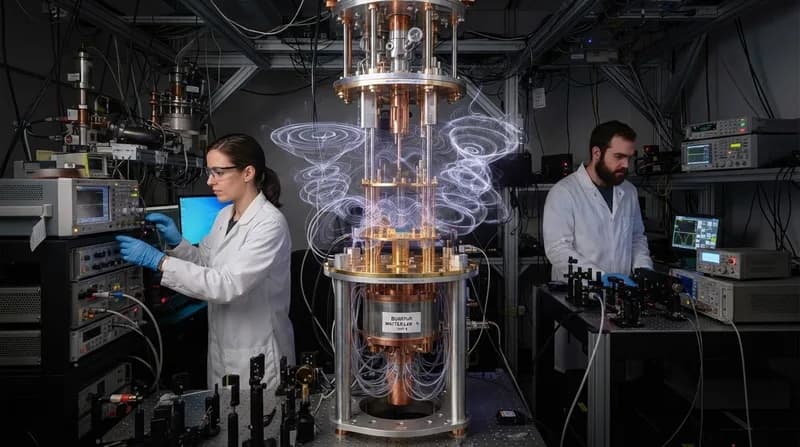
The study, published in the journal Nature, centers on the concept of 'vacuumronics.' While quantum fluctuations—the transient, energetic flickering of virtual particles—are a fundamental reality of the universe, they are typically too weak to have a measurable impact on macroscopic systems. To bridge this gap, the research team utilized a terahertz split-ring resonator, essentially creating a 'dark cavity' that reshapes the local electromagnetic environment. This manipulation allowed them to substantially amplify these fluctuations, creating a specialized vacuum state that interacts directly with the material placed within it.
The NbSe2 Experiment
The core of the experiment involved placing a six-layer ultrathin superconducting material, NbSe2, into the engineered environment of the terahertz dark cavity. By doing so, the researchers created a coupled system where the material and the vacuum fluctuations could interact at a fundamental level. The results were stark: the superconducting critical temperature—the threshold at which the material begins to conduct electricity without resistance—rose by as much as 5.4%.
Furthermore, the researchers observed significant improvements in the material's critical current and its tolerance to magnetic fields near the transition point. To ensure the findings were not the result of external interference, the team conducted extensive control experiments, varying everything from the cavity's geometric dimensions to the thickness of the dielectric materials. They ruled out conventional explanations such as strain, material degradation, or screening effects. The presence of a resonance-like peak—occurring only when the cavity’s photonic properties matched the material's internal fluctuations—provided compelling evidence that the vacuum environment was the active force behind the enhancement.
Why It Matters
This development signifies a shift in how we approach material science, transitioning from modifying the internal chemistry of a substance to modifying the 'stage' upon which the substance sits. By utilizing virtual photon exchange, the researchers managed to lower the energy state of the superconductor, making the superconducting state more stable and efficient.
- Non-Contact Control: This method provides a way to influence quantum states without the need for external energy sources or direct physical contact.
- New Design Parameters: It introduces the potential to build 'vacuum-engineered' hardware, where cavity geometry is just as important as the material composition itself.
- Scalability: With further refinement of cavity structures, this coupling mechanism could eventually be applied to a wider range of quantum materials, potentially paving the way for more efficient quantum computing components and high-energy power systems.
As Nobel Laureate Frank Wilczek noted, this research demonstrates that the vacuum is no longer just a passive container; it is an active participant. Moving forward, the refinement of this vacuum-fluctuation coupling could open the door to unprecedented control over quantum matter, offering a sophisticated, non-invasive method for pushing the limits of current superconducting technology.