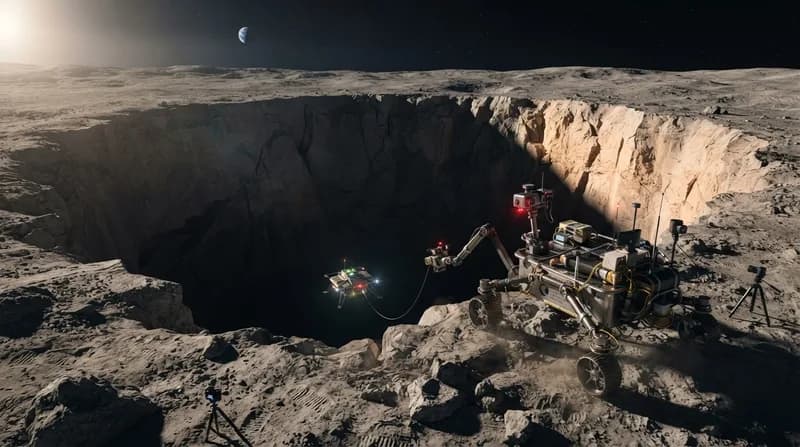
The GIMLI Initiative: Unveiling the Lunar Subsurface
NASA has officially selected a cutting-edge project, the Geophysical Instruments for Marius Lunar pit Investigation (GIMLI), to explore the secrets hidden beneath the lunar surface. Led by the Planetary Science Institute (PSI), this mission marks a critical shift from orbital observation to direct, on-the-ground exploration. By targeting the Marius Hill Pit (MHP), researchers hope to confirm whether this deep opening is a natural skylight leading into a sprawling system of ancient lava tubes.
The significance of this mission cannot be overstated. Should GIMLI successfully identify a substantial underground cavern, it would provide a blueprint for future lunar exploration. Such subterranean environments offer a unique, naturally occurring buffer against the harsh realities of the Moon, including intense solar radiation and the extreme temperature swings that occur between the lunar day and night. For human explorers, these voids could serve as the foundation for permanent, shielded habitats.
State-of-the-Art Sensing Technology
The GIMLI payload is a marvel of miniaturized engineering, designed to peer beneath the crust of the Moon with unprecedented precision. The project team, in partnership with Honeybee Robotics—a subsidiary of Blue Origin—is developing a suite of instruments that will be deployed via a robotic lander and rover. This toolkit represents a return to active-source seismology, a technique not utilized on the Moon since the era of the Apollo missions.
- Active-Source Seismic Sensors: These devices will generate controlled vibrations, allowing scientists to map subterranean structures based on how seismic waves travel through the lunar crust.
- Ground-Penetrating Radar (GPR): Supplied by the Norwegian Space Agency, the GPR will provide high-resolution imaging of the subsurface, identifying anomalies and potential void boundaries.
- Precision Gravimeter: This instrument will measure minute variations in local gravity, helping the team determine the density and dimensions of any detected voids.
- High-Resolution Cameras: Strategically placed cameras will capture detailed imagery of the lunar surface and the exposed geological layers within the pit walls.
Implications for Lunar Science
Even in the event that no massive cavern is discovered, the mission is poised to deliver a wealth of geological data. The Marius Hill Pit acts as a rare window into the Moon's interior; its exposed walls reveal layers of regolith and ancient lava flows that have remained untouched by the erosive forces of space for eons. By analyzing these cross-sections, researchers expect to refine their understanding of the Moon’s volcanic history and the timeline of its past eruptions.
Gareth Morgan, a senior scientist at PSI, notes that the study of these features aligns lunar geology with established knowledge of basaltic volcanism on Earth. If the team confirms that lunar lava tubes mirror their terrestrial counterparts, it will validate a new model for interpreting the volcanic evolution of our celestial neighbor. With the support of international partners and commercial entities, GIMLI is not just an exploration of a hole in the ground; it is an investigation into the fundamental history of the Moon itself.