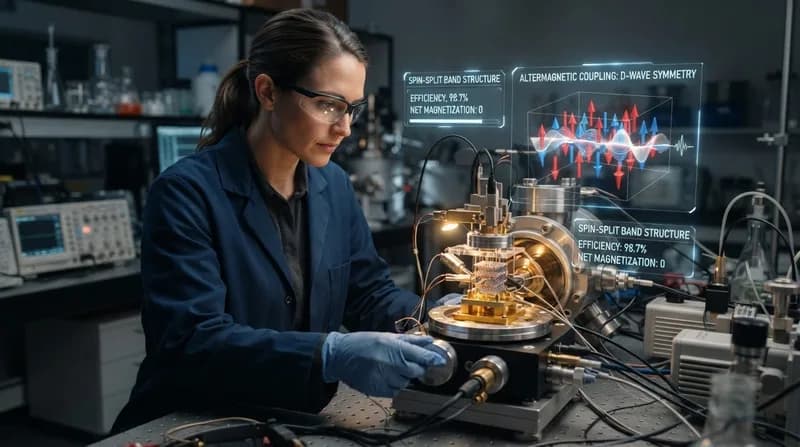
The Spintronics Revolution
For decades, the foundation of modern computing has remained rooted in the movement of electrical charge. However, as our devices shrink and power demands increase, we are approaching the physical limits of charge-based electronics. A research team led by the University of Central Florida (UCF) has potentially charted a path forward by identifying a new form of magnetism—known as altermagnetism—in a highly tunable, layered material. This discovery could shift the industry toward spintronics, an emerging field that processes information by manipulating the intrinsic spin of electrons rather than just their charge.
By controlling electron spin, future devices could operate at significantly higher speeds while consuming only a fraction of the energy required by current silicon-based hardware. The core challenge, however, has been finding a material that provides the benefits of magnetism without the physical drawbacks that cause interference in dense, high-performance circuitry.
The Dual Nature of Altermagnets
To understand why this discovery is significant, one must distinguish between the two primary forms of magnetism currently known to science. Ferromagnets, the traditional magnets we encounter daily, provide strong, useful magnetic fields, but their tendency to create stray magnetic interference makes them difficult to integrate into tiny, high-density electronic components. Conversely, antiferromagnets effectively cancel out these stray fields by having magnetic moments that point in opposite directions, but they typically lack the specific electronic properties required for advanced computing tasks.
Altermagnets bridge this gap. They function as a hybrid, offering the best of both worlds: they operate without generating the disruptive stray fields associated with ferromagnets, while simultaneously maintaining the spin-related electronic characteristics that allow for the generation and detection of spin currents. This combination makes them an ideal candidate for future memory devices, ultrafast network components, and ultra-efficient processors.
The Role of Co1/4TaSe2
The research team identified the experimental signature of altermagnetism in a layered material called Co1/4TaSe2. This transition-metal dichalcogenide (TMD) is comprised of magnetic cobalt atoms sandwiched between layers of other elements. Because these layers are only weakly connected, they can be separated or stacked, providing researchers with a flexible, highly tunable platform for exploration.
Using high-resolution angle-resolved photoemission spectroscopy (ARPES), the team successfully measured the energy and motion of electrons within the material. They confirmed the existence of split electronic bands where the states possess opposite spin polarizations—a definitive mark of altermagnetic behavior. Unlike previous theories that were unsure if these properties were localized to the surface, the team’s findings demonstrate that this altermagnetic order originates from deep within the material structure, proving its viability for bulk-integrated device applications.
Why It Matters
- Speed: Spintronic devices can switch states much faster than conventional charge-based transistors.
- Efficiency: Moving electron spin requires less energy, potentially extending battery life in mobile devices and reducing the heat output of large-scale data centers.
- Density: By eliminating stray magnetic interference, these materials allow for tighter packing of electronic components without data corruption.
- Tunability: The layered nature of Co1/4TaSe2 allows engineers to modify properties at the atomic level, making it a versatile tool for future R&D.
As the scientific community continues to explore the nuances of altermagnetism, this new material serves as a crucial testing ground. While significant questions remain regarding how these materials behave under varying conditions and exactly how the magnetic order arises from competing interactions, the identification of a stable, tunable platform is a major leap forward for next-generation hardware.