Charting a Course to the Red Planet
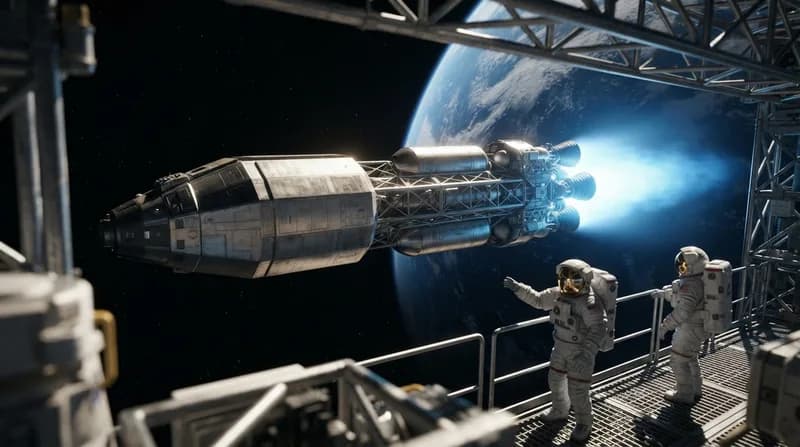
NASA has reached a critical milestone in its quest to revolutionize deep-space exploration. Following a comprehensive mission review held in October, the agency has finalized the primary design architecture for its Space Reactor-1 (SR-1) Freedom spacecraft. As the first fission-powered vessel intended to operate beyond Earth's orbit, SR-1 Freedom represents a significant leap forward in propulsion technology, aiming to leverage nuclear electric power to deliver specialized cargo to the Martian environment.
The mission, which is currently slated for a late 2028 launch, involves transporting the 'SkyFall' capsule, a delivery vehicle housing three advanced Ingenuity-class helicopters. By utilizing a nuclear fission reactor, NASA aims to demonstrate the viability of long-duration power generation in deep space, providing a sustained energy source that outclasses traditional solar-only configurations for specific mission profiles.
Refinements and Strategic Upgrades
Refining the spacecraft's physical form has been a priority for the engineering teams involved. Recent adjustments to the design have resulted in a shorter boom length between the nuclear reactor and the main chassis. This modification is not merely cosmetic; it is a calculated engineering decision that improves shielding efficacy while reducing the overall mass of the craft. By streamlining the structure, NASA aims to simplify the assembly process and enhance the durability of the onboard electronics and sensitive payload components against radiation.
Communication capabilities have also received a notable boost. The updated design incorporates larger X-band antenna dishes, ensuring that data transmission back to Earth remains robust despite the vast distances of interplanetary space. These hardware enhancements are complemented by a strategic partnership with Johns Hopkins University’s Applied Physics Laboratory, which recently secured a $39.3 million contract to engineer the essential heat rejection systems required to manage the reactor's thermal output.
Why It Matters
- Pioneering Propulsion: SR-1 Freedom serves as a flight-test platform for nuclear electric propulsion, a key technology for faster, more efficient interplanetary transit.
- Mission Flexibility: The dual-power approach—utilizing solar arrays for the cruise phase and reserving nuclear power for orbit insertion and operational testing—optimizes energy management.
- Advanced Robotics: The delivery of multiple Ingenuity-class helicopters signals a shift toward deploying swarms of aerial explorers to survey the Martian landscape.
The Race Against the Launch Window
While the design framework is now established, the timeline remains incredibly tight. With the launch window set for late 2028, NASA has approximately two years to complete the detailed design, physical construction, and rigorous pre-flight testing phases. This ambitious schedule places the project in competition with other high-profile missions, such as the European Space Agency’s long-delayed Rosalind Franklin rover, which is also targeting a similar timeframe.
As the project matures, NASA continues to deliberate on several technical variables, including the precise number of radiator panels required for optimal cooling and the exact power output levels for the reactor module. Successfully navigating these final engineering hurdles is essential for maintaining the current schedule, as missing the upcoming Mars departure window could significantly impact the project's long-term deployment viability.