The Impact's Lasting Legacy
When NASA intentionally slammed the DART (Double Asteroid Redirection Test) spacecraft into the asteroid Dimorphos in 2022, the primary goal was to prove that humanity could alter a celestial object's trajectory. Now, years later, the European Space Agency’s (ESA) Hera probe has arrived on the scene to document the physical aftermath of that historic kinetic collision. The findings are nothing short of transformative for planetary defense research.
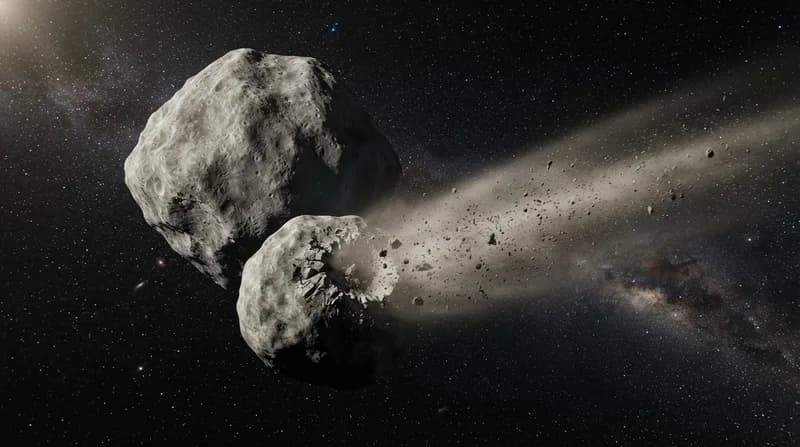
Data transmitted by the Hera probe indicates that the collision did far more than provide a simple nudge. The impact created a massive, stadium-sized crater that spans nearly the entire width of the 151-meter-wide asteroid. Scientists, who previously debated whether the collision would result in a crater, a shape change, or no structural damage at all, were stunned to discover that the asteroid had experienced all three simultaneously. Furthermore, the asteroid is now exhibiting a distinct tumbling motion as it travels through its orbit.
Navigating a Debris Field
Hera is currently conducting a delicate survey of the Dimorphos-Didymos system, maintaining a distance of approximately 25 to 30 kilometers. Rather than relying on standard circular orbital patterns, the craft performs carefully calculated rectangular maneuvers at a speed of roughly 12 centimeters per second. This cautious approach is necessitated by a significant field of hundreds of loose boulders and debris surrounding the asteroids, remnants of the high-velocity impact that now complicate close-range navigation.
As the mission progresses, the team intends to bring the spacecraft as close as 13 kilometers to the surface to capture higher-resolution imagery. This closer perspective is vital for the next phase of the mission, which involves the deployment of two specialized CubeSats in early 2027. The Italian-led Milani CubeSat is designed to analyze surface composition and dust characteristics, while the Luxembourg-led Juventas will utilize radar technology to peer beneath the surface and map the asteroid's internal structure before attempting a landing.
Why it Matters
- Deflection Efficacy: By accurately measuring the mass of Dimorphos and comparing it to the known orbital shift, scientists can refine the momentum transfer models used for future planetary protection strategies.
- Structural Insights: Understanding how a low-density, rubble-pile asteroid reacts to high-velocity impacts provides critical data for designing future interception missions.
- Global Collaboration: The synergy between NASA’s initial impact mission and the ESA’s observational follow-up exemplifies the international cooperation required to build a reliable defense system against potential near-Earth object threats.
Ultimately, the Hera mission is the second half of a grand experiment. While DART proved we have the capability to knock an asteroid off its path, Hera is revealing the mechanical nuances of how those objects react to such an encounter. This combined knowledge is essential for transforming the concept of planetary defense from a theoretical framework into a reliable, operational tool for shielding Earth from future cosmic hazards.