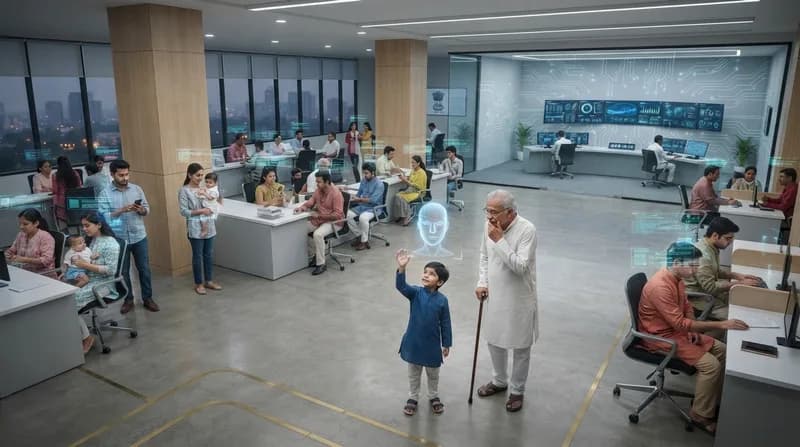
The Vision of Lifelong AI Guidance
The Indian government has unveiled a bold, albeit contentious, proposal to integrate artificial intelligence into the fabric of daily life, spanning from early childhood development to adulthood. Prime Minister Narendra Modi recently outlined a vision for a government-managed application designed to track a child’s progress from the age of three. By aggregating data points from parents, teachers, and peers, the system intends to profile a child’s specific aptitudes and interests, effectively acting as an automated career and educational counselor. The government suggests this data-driven approach could eventually guide families toward the most appropriate tertiary institutions, ostensibly streamlining the high-stakes, competitive path to higher education.
The Uttar Pradesh 'AI Stack' Initiative
Beyond national educational goals, India’s most populous state, Uttar Pradesh, is embarking on a massive technological overhaul known as the 'AI Stack.' Detailed in a 178-page tender, this project seeks to utilize a unique Family ID system to consolidate disparate data across multiple state agencies. The ambitious platform is designed to power over a dozen distinct AI use cases, ranging from specialized healthcare assistant tools to custom content generators for educators. By leveraging self-hosted, open-weight models, the state aims to maintain control over the infrastructure while delivering personalized government services directly to the public through natural language interfaces.
Social Monitoring and Surveillance Concerns
A particularly polarizing component of the UP AI Stack is the proposed 'AI-Enabled Social Media Monitoring and Urban Grievance Detection' system. This tool is designed to scrape social media and online news to automatically identify service interruptions, infrastructure issues, and citizen complaints. While the stated goal is to accelerate government response times—such as dispatching road repair crews—critics and civil liberties groups like the Internet Freedom Foundation are sounding the alarm. The primary concern lies in the ambiguity of the tender, which could theoretically allow the government to link this monitoring suite to broader security apparatuses. Given the history of internet shutdowns in the region, observers worry that such a robust AI infrastructure could be repurposed for mass surveillance or the suppression of dissent rather than mere urban optimization.
Why It Matters
This initiative represents one of the most comprehensive attempts globally to apply AI to state-level governance. While the technology promises to reduce bureaucracy and provide personalized assistance to millions, the lack of explicit legislative guardrails raises fundamental questions about data sovereignty and the right to privacy. The project serves as a high-stakes litmus test for whether AI can genuinely improve public service delivery without sacrificing the democratic freedoms of the citizenry it intends to serve.