A New Benchmark for Orbital Transit
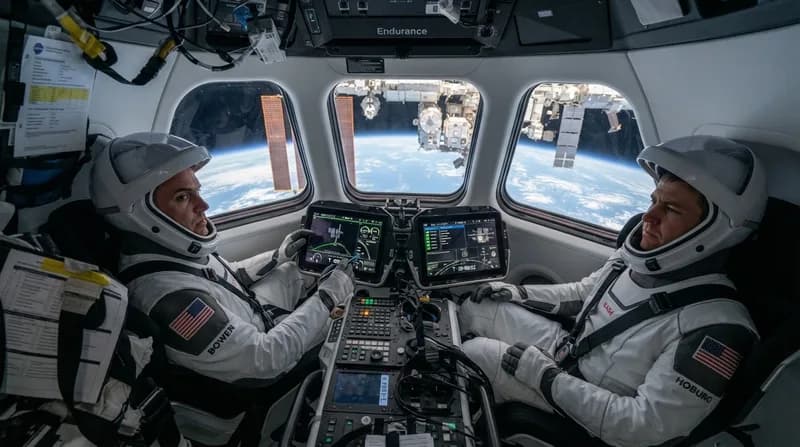
NASA and SpaceX are pushing the boundaries of orbital efficiency with the upcoming Crew-13 mission. Scheduled to launch from the Space Launch Complex 40 at Cape Canaveral Space Force Station, the mission aims to deliver its four-person crew to the International Space Station (ISS) in a blistering 7 hours and 50 minutes. This transit time, if achieved, will officially mark the fastest journey ever performed by a U.S. spacecraft to the orbiting laboratory, demonstrating significant advancements in mission planning and orbital mechanics.
The SpaceX Dragon spacecraft is currently perched atop a Falcon 9 rocket, undergoing final checks to ensure readiness for the October 1 launch. This mission represents the 13th rotation under NASA's Commercial Crew Program, highlighting the maturing relationship between private aerospace hardware and government exploration goals. By optimizing the approach trajectory and rendezvous sequences, mission controllers are minimizing the time astronauts spend in the cramped confines of the capsule, moving toward a more streamlined standard for future human spaceflight.
The Crew-13 Roster
- Jessica Watkins (NASA): Veteran astronaut bringing critical expertise to long-duration missions.
- Luke Delaney (NASA): A key contributor to this rotation's objective-driven science agenda.
- Joshua Kutryk (CSA): Representing the Canadian Space Agency and ongoing international cooperation in orbit.
- Sergey Teteryatnikov (Roscosmos): A vital member of the international team ensuring continued global collaboration aboard the ISS.
Why It Matters
Reducing the time taken to reach the ISS is more than just a logistical feat; it is a vital step toward improving astronaut health and operational safety. Extended periods in a microgravity environment, even within the confines of a spacecraft, present unique physiological challenges. By compressing the arrival timeline, NASA and SpaceX reduce the physical stress on the crew during the critical ascent and docking phases. Furthermore, this rapid-transit capability underscores the agility of the Falcon 9 and Dragon ecosystem, which has become the workhorse of modern American spaceflight. As we look toward long-term lunar and Martian missions, the ability to execute precise, high-speed maneuvers remains a foundational skill for deep-space exploration.
Mission Outlook and Implications
Once docked to the Harmony module's forward-facing port, the Crew-13 team will initiate a brief handover period with the Crew-12 astronauts, who are slated to return to Earth shortly thereafter. The arrival is not just about the personnel rotation; it serves as a platform for a sustained period of scientific research. The crew will be tasked with numerous experiments that leverage the station’s unique environment, ranging from human physiology to material science. This mission reinforces the status of the ISS as an essential, high-functioning testbed for technologies that will eventually facilitate humanity’s reach further into the solar system. For observers, the broadcast of this record-breaking transit serves as a reminder of the consistent, high-stakes progress occurring just a few hundred miles above the Earth's surface.