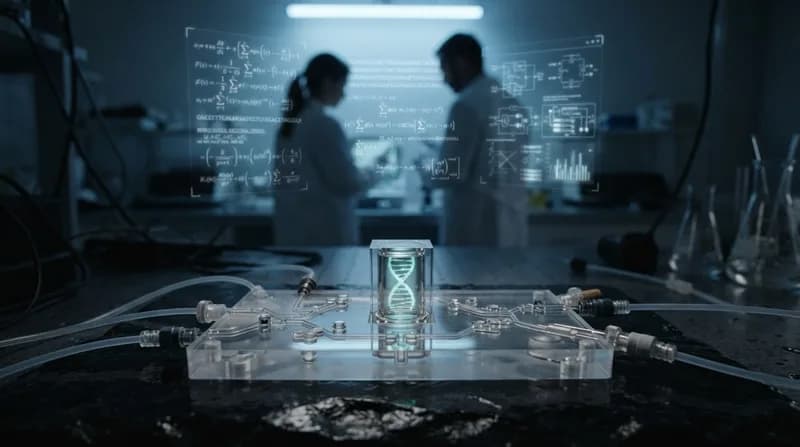
A New Paradigm in Computational Physics
In a groundbreaking shift from traditional silicon-based architecture, researchers at Maynooth University have unveiled a DNA computer that functions by reaching thermodynamic equilibrium. Led by Damien Woods, the team has successfully demonstrated that computing does not always require the massive energy expenditure associated with keeping a system far from equilibrium. By leveraging the principles of molecular thermodynamics, this project moves past the constraints of conventional hardware, effectively allowing a system to drift naturally toward the correct answer as it stabilizes.
The inspiration for this breakthrough traces back to the 1970s, when physicist Charles Bennett proposed that computation could, theoretically, be modified to operate with reversible dynamics. By operating close to thermal equilibrium, such a computer would drastically reduce energy demand. Woods and his team have moved this concept from theory to laboratory reality, creating a platform where the most stable state of the system is the calculation’s output.
The Mechanics of DNA Tiles
The system utilizes a technique inspired by "DNA origami," where a long, single-stranded DNA scaffold is introduced to a solution containing a variety of shorter DNA strands. These shorter strands, referred to as "tiles," represent the potential values for each step of a logic operation. When mixed, these tiles engage in a competitive binding process, a concept pioneered in the 1990s by Erik Winfree.
As the mixture settles, the tiles vie for position along the DNA scaffold. The "winning" tile at any given binding domain is the one that achieves the most favorable thermodynamic bond with both the scaffold and its neighboring tiles. This continuous competitive binding serves as the execution engine for the algorithm. Once the system finishes rearranging its molecular components, the final state represents a completed computation, with the sequence of bound tiles acting as the stored result.
Why it Matters
- Energy Efficiency: By operating at thermodynamic equilibrium, these systems avoid the high energy costs required to maintain non-equilibrium states in traditional silicon chips.
- Molecular Reusability: The platform is remarkably durable. Researchers demonstrated that the same molecular computer could be reused up to 25 times on different inputs, with experiments remaining viable even after 15 months of storage.
- Algorithmic Versatility: The team successfully validated the system across 10 distinct programs, performing foundational operations including addition, multiplication, and division.
Outlook and Implications
The success of the Maynooth team, which includes researchers Tristan Stérin and Constantine Evans, provides a scalable blueprint for future molecular computing. The ability to perform hundreds of distinct computations with a relatively simple experimental setup suggests that DNA-based logic is moving closer to practical application. While current computation times range from one minute for simple tasks to longer durations for complex sequences, the ease of preparation and the inherent stability of the DNA tiles represent a significant leap forward in the field of non-conventional computing. As this technology matures, it could offer a low-power, biological alternative for specific types of data processing and complex molecular logic tasks that remain inefficient on standard electronic hardware.