The End of a Four-Decade Paleontological Mystery
For nearly forty years, the scientific community has been captivated and confused by zhelestids—a group of small, rabbit-like mammals from the Cretaceous period. Because previous discoveries were largely limited to isolated teeth, paleontologists struggled to place these creatures on the family tree. Their specialized, plant-grinding teeth led many to hypothesize that zhelestids were early, primitive ancestors of modern placental mammals. However, a stunningly complete fossil discovery in Mongolia’s Gobi Desert has finally put that theory to rest.
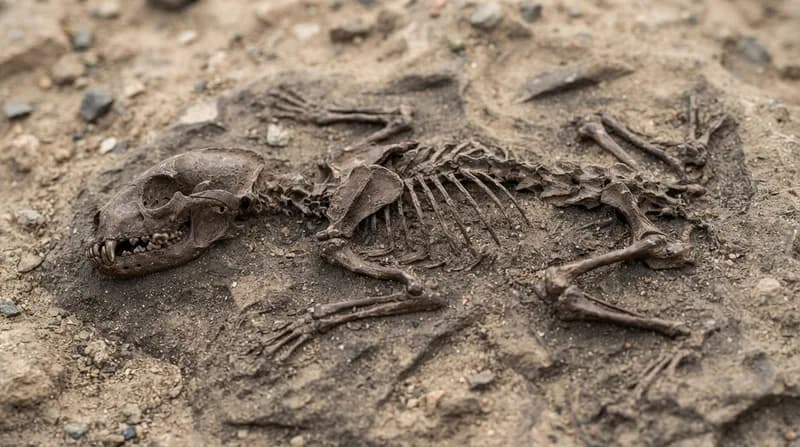
The newly identified species, Tamirkhan balcarceli, was unearthed during a museum-sponsored expedition and is the most intact zhelestid specimen ever recovered. By examining the creature’s full skeletal structure—beyond just its teeth—researchers have determined that zhelestids were not part of the placental line at all. Instead, they belonged to a completely separate, distinct group of early mammals known as zalambdalestoids, a lineage characterized by shrew-like insectivores.
The Anatomy of Tamirkhan balcarceli
The physical evidence provided by Tamirkhan balcarceli is transformative. Measuring approximately 6 to 7 inches in length, the animal possessed features that contradict earlier assumptions based solely on dental records. While its teeth were indeed low and rounded—a trait that had previously fooled scientists into grouping them with hoofed mammals—the rest of the skeleton tells a different story. The fossil displays long, continuously growing incisors and specific skull morphology that link it directly to zalambdalestoids.
Perhaps most telling are the specimen's hind legs. The discovery reveals long, slender limbs and unique ankle structures that are hallmarks of the zalambdalestoid group. This combination of traits serves as a masterclass in convergent evolution, where unrelated species independently develop similar physical characteristics due to comparable environmental pressures. In this case, the zhelestids evolved plant-grinding teeth similar to later placental mammals, even though their evolutionary roots were firmly planted elsewhere.
Why This Matters
- Beyond Teeth: This discovery serves as a cautionary tale against relying too heavily on single-organ data (like teeth) to reconstruct an entire evolutionary history, a method once championed by naturalist Georges Cuvier.
- Convergent Evolution: The study provides clear evidence of how unrelated mammals can evolve similar dietary adaptations, complicating the way we interpret fossil records.
- Methodological Advancement: Researchers utilized the MorphoBank database to integrate this fossil into a comprehensive evolutionary framework, proving the value of digital, collaborative research tools.
- The Gobi's Significance: Once again, the Gobi Desert has proven itself as the world’s premier laboratory for vertebrate paleontology, yielding remains that allow scientists to revise the history of early life.
Implications for Future Research
This finding does more than just categorize one small mammal; it forces a re-evaluation of how we interpret the diversity of life during the age of dinosaurs. If zhelestids were not placental mammals, it implies that Cretaceous mammal diversity was less about a single lineage diversifying into modern groups and more about a complex web of independent lineages with shared evolutionary traits. As lead researcher Andres Giallombardo noted, this discovery highlights that while molecular models can predict the past, only physical fieldwork can provide the empirical evidence required to verify those complex theories.