A Surprising Culprit in Space Weather
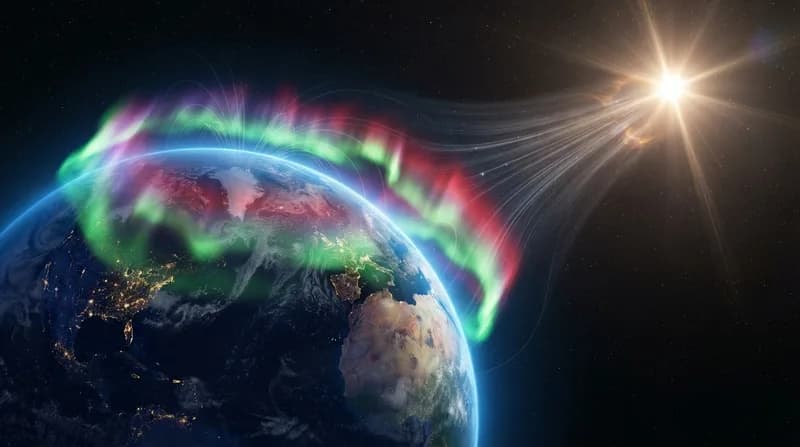
When the solar superstorm of May 2024 illuminated skies with auroras in regions that rarely witness them, it was assumed to be a pure display of solar fury. However, new research from Nagoya University, published in Science Advances, suggests that the planet itself acted as a silent partner in the chaos. While the storm was triggered by solar eruptions, data from the Japanese Arase satellite indicates that Earth’s own upper atmosphere provided approximately 85% of the charged particles that fueled the resulting geomagnetic disturbance.
For decades, the scientific community operated under the assumption that the solar wind—the stream of charged particles flowing from the Sun—was the primary driver of such events. This new discovery upends that understanding, revealing that the ionosphere, a layer of Earth's upper atmosphere, can contribute significantly more material to the planet's ring current than previously believed. This influx of heavy oxygen and hydrogen ions effectively amplified the storm’s impact, creating a more intense magnetic disturbance than solar particles alone could have generated.
The Anatomy of a Disturbance
The May 2024 event, often referred to as the Gannon storm, achieved a remarkable SYM-H index reading of -518 nanotesla, marking it as the second-largest geomagnetic disturbance since 1981. The Arase satellite, positioned in the ring current—a belt of charged particles circulating around the planet—provided a front-row seat to the event. The instruments aboard were able to analyze the mass and energy of individual ions, allowing researchers to confirm the terrestrial origin of the majority of the particles involved.
Beyond the particle composition, the satellite recorded a staggering 40% weakening of Earth’s magnetic field at an altitude of approximately 16,000 kilometers. This reduction in magnetic intensity happened much closer to the planet than historical data had suggested was possible. Scientists are still investigating whether this deformation of the magnetic field directly led to the observed loss of energetic electrons in the region, but the correlation marks a significant milestone in our understanding of space weather dynamics.
Why it Matters
- Forecasting Accuracy: Current models focus heavily on solar wind data. This research proves that atmospheric conditions on Earth are equally critical for predicting the severity of incoming solar storms.
- Critical Infrastructure: Improving our predictive capabilities is vital for protecting global power grids, GPS navigation, and satellite communication networks that are highly susceptible to geomagnetic interference.
- New Research Directions: The findings lend significant weight to proposed space missions, such as the Japanese "FACTORS" project, which aims to further study how terrestrial ions migrate into the magnetosphere.
Implications for Future Space Missions
The realization that Earth’s atmosphere plays such a dominant role in geomagnetic storms fundamentally changes how space weather experts approach their work. Moving forward, the integration of atmospheric outflow data into predictive models will be essential for building a more resilient technological infrastructure. The ability to distinguish between solar-sourced and Earth-sourced interference could allow for more nuanced warning systems for satellite operators and power grid managers.
As space agencies look toward future missions like FACTORS, the goal is to map the specific mechanisms that allow atmospheric ions to flow into space. By capturing the complete lifecycle of these particles during extreme events, scientists hope to move away from reactive forecasting toward a proactive system that can anticipate how the Earth will respond to the Sun’s volatile outbursts. This shift in perspective ensures that the next "monster storm" will be met with a much clearer understanding of the forces at play.