The 1,000 Days Project: Capturing the Linguistic Frontier
For decades, developmental psychologists have debated how human infants manage a feat that continues to baffle AI researchers: mastering language from a chaotic, noisy, and non-structured environment. Unlike large language models that consume vast swathes of the written internet, children learn from limited, personalized, and often disorganized input. A landmark study from Princeton University, titled the 1,000 Days Project, has finally cracked open this "black box" of early childhood development by creating an unprecedented data set of the first three years of life.
To build this archive, researchers deployed cameras and microphones in the homes of 15 families, capturing the day-to-day interactions of infants from birth through age three. This massive repository provided the team with an exceptionally dense record of exactly what a child hears—the breakfast chatter, the storybook sessions, and the background noise of family life. By transforming this raw audio into a dataset for artificial learners, the team aimed to test a fundamental hypothesis: could an algorithm, when fed only the specific, chronological experiences of an individual child, mirror the human process of language discovery?
The Critical Role of 'Replay'
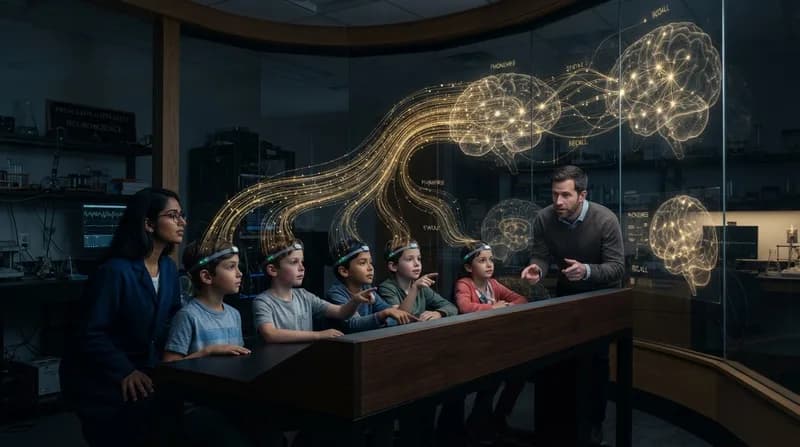
The research team, led by Dr. Hadas Raviv and Principal Investigator Uri Hasson, initially encountered a significant failure. When they simply fed a model the raw stream of audio from a child named Coral, the AI learned virtually nothing. By the time it reached the virtual age of two, the system had failed to retain or categorize even the simplest vocabulary. The breakthrough came when the researchers realized their model lacked a biological necessity: sleep-associated memory consolidation.
In human neurology, sleep is the period where the brain revisits and "replays" the day's experiences, cementing new neural pathways. By implementing a computational "replay" mechanism—where the model was programmed to revisit snippets of its daily input during a nightly downtime—the system’s performance changed dramatically. The model began to identify phonemes, recognize recurring words, and eventually develop a vocabulary of thousands of words, successfully mirroring the linguistic milestones of the children in the study.
Why it Matters: A New Paradigm for Development
This study represents a fundamental shift in how we approach both artificial intelligence and developmental psychology. By moving away from massive, generalized datasets and toward personalized, chronological learning, the team has provided a new tool for verifying theories about how children learn.
- Verification through Creation: The project aligns with physicist Richard Feynman’s philosophy: "What I cannot create, I do not understand." By building a system that replicates childhood learning, researchers can pinpoint exactly what biological components—such as social interaction, visual cues, or memory consolidation—are required for cognitive growth.
- Individual Trajectories: The research highlights that every child follows a unique path. By adjusting variables like the rate of replay and learning speed, the team could accurately model the specific developmental pace of different children.
- Beyond Superhuman AI: While modern industry focuses on AI that outperforms humans, this research focuses on the nuance of human-level intelligence, aiming to bridge the gap between biological brains and synthetic learning systems.
Ultimately, the 1,000 Days Project confirms that language isn't just about the data ingested; it is about the architecture of the learner. As the team continues to incorporate visual data, social interactions, and physical context into their models, they hope to unlock a deeper understanding of how the "mess" of everyday human experience transforms into the foundational structure of human thought.